Olive

Olea europaea
Divine Blessing - Wisdom - Ancestral Gifts - Perspective
Despite over 5,000 years under human cultivation, the Olea europaea remains wild-looking and ancient, with some trees surpassing 1,000 or 2,000 years of age. Surviving fires, drought, and even a complete cutting back to the stump, the olive tree will just not give up. This is a formidable, primordial, and powerful tree, a teacher of perspective, and a reminder of the ancestral gifts of awe, gratitude and humility. Associated with the goddess Athena as well as Zeus and the patron of human culture, Aristaeus, the Olive was a sacred symbol of divine blessing and wisdom. Still prized today for the oil pressed from its fruit, the olive is a staple of modern Greek cuisine. Keep reading below to learn more about the Olive.
Index
The Olive in the Wild & Garden

Image by Amédée Masclef / Public domain via Wikimedia Commons
LATIN BINOMIAL
Olea europaea
PLANT FAMILY
Oleaceae
COMMON ENGLISH NAMES
Olive
COMMON GREEK NAMES
modern Greek: ελιά; ancient Greek: ἐλαία
CHARACTERISTICS
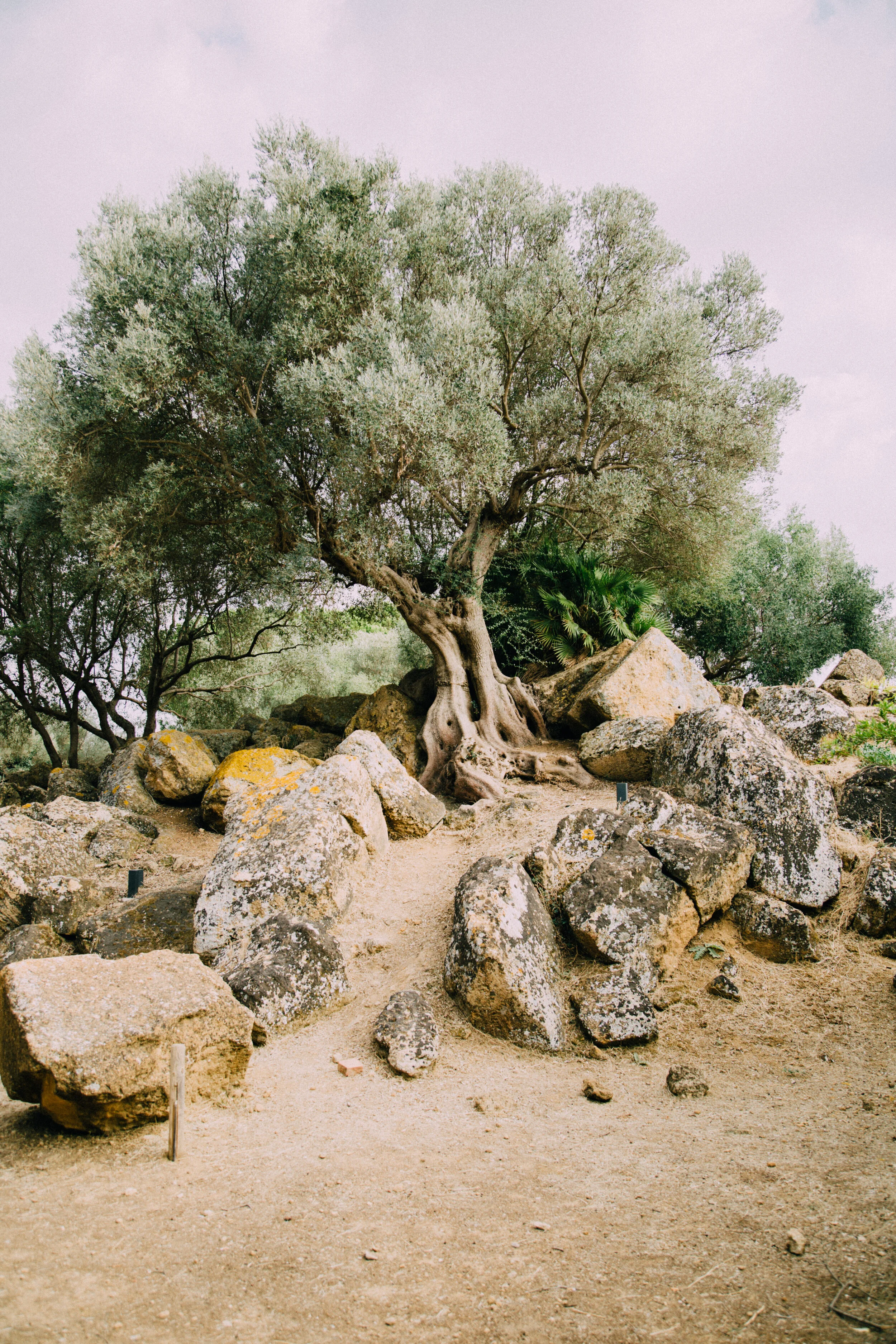
slow-growing, drought-tolerant evergreen shrub or tree with gnarled and twisting trunk and oblong silver-grey-green leaves; some trees are believed to be over 2000 years old; consistently regenerate after fires and even after a complete cutting back to the stump
NATIVE HABITAT
Asia Minor and the Mediterranean basin
PREFERRED CLIMATE & CONDITIONS
Prefers full sun and slightly poor soil, especially in relative close proximity to the sea. Hardy in Zones 8 to 11.
TYPICAL HEIGHT AND SPREAD
up to 15 meters (50 feet) in height
BLOOM COLOR AND CHARACTER
small white flours bloom in late spring to early summer and produce bitter, oblong drupes that start green and mature to dark purple in autumn/winter; drupe contains a hard seed, often called a stone or pit
COMMON DISEASES
fairly disease-resistant, but can succumb to olive fruit fly or various fungal and bacterial infections

NOTES ON PROPAGATION, HARVEST, AND PRESERVATION
The olive has been in cultivation for over 5,000 years and hundreds of cultivars exist, with fruits varying in size, shape, and flavor; particular varieties are better suited for table olives or for pressing.
One of my favorite museums in Greece is The Museum of the Olive and Greek Olive Oil in Sparta, where you can see amazing exhibits about the olive’s cultivation (including life-size replicas of the evolution of the oil press) and the history of its use in medicine, cosmetics, religious ceremony, and cooking.
Propagate: grow from cuttings grafted on a wild or cultivated root stock
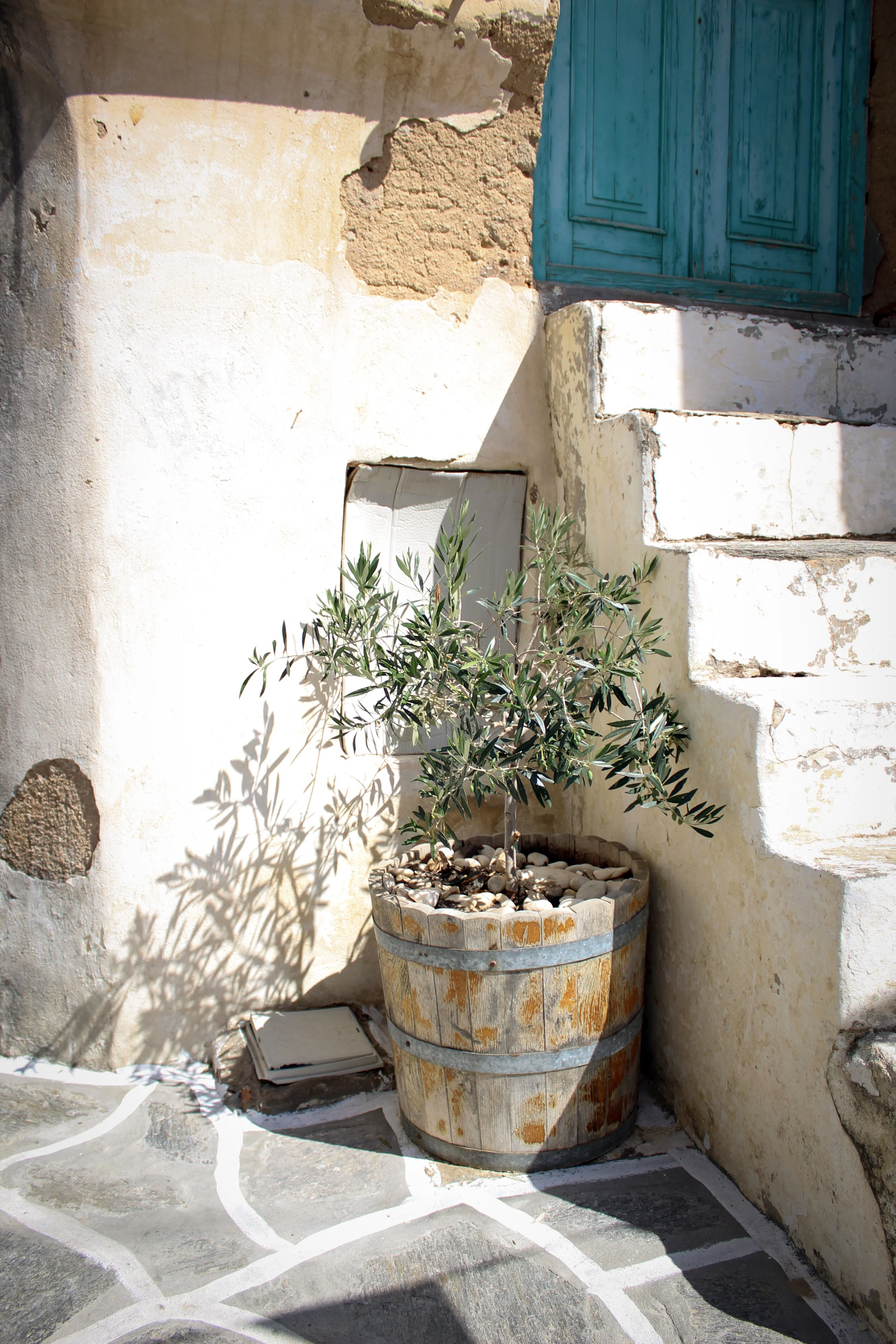
Grow: often grown in groves, it can also be grown as a single tree as most trees are self-fertilizing, meaning they do not need a partner tree, wind or pollinators in order to produce fruit (the pollen will fall from the stamen by itself), although there are exceptions to this; they can also be grown in containers
Prune: usually pruned into a tree shape for maximum fruit yield, often with an open center to encourage light and airflow to inner branches; pruned yearly in late winter/early spring; for ornamental purposes, can be left alone to form a shrub
Harvest: olives for eating and oil: olives are shaken from the branches onto ground cloths and gathered for brining or pressing in autumn (green olives) or winter (purple/black olives); wood and leaves: any time of year
Preserve: fresh olives are pressed to extract the oil; olives are unpalatably bitter and must be cured in brine; olive leaves can be dried or tinctured


The Olive in Greek Mythology
Athena: a Gift to Athens
The most famous story of the olive tree is that of Athena, goddess of wisdom, war, and weaving.

It is said that both she and Poseidon, god of sea and earthquakes, sought to make the region of Attica their own. In a contest to see who would bear the best gift to the region, Poseidon struck the ground with his trident, bringing forth a rush of saltwater (in another version, he gave the first horse). Athena, in response, offered the first cultivated Olive tree.
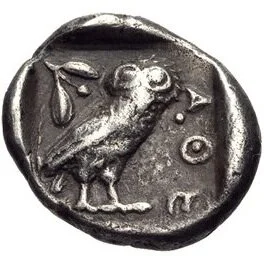
Athena’s offering was voted to be a superior gift for humankind and she became patron of the region’s city, naming it after herself (Athens) and planting the first olive tree on its Acropolis, where her sacred temple, the Parthenon, was then built. The olive branch was thus included on coins from the city, along with her sacred animal, the owl, to denote the goddess’s sacred patronage.
As an origin story for the city of Athens, this points to the importance of the olive for Greek civilization and its perceived blessing upon humanity. And indeed the olive was a vital source of food, medicine, cosmetics, light, and religious importance for the ancients of the Mediterranean, including the Minoans and Mycenaeans.
Herakles: A Gift to Zeus
“But Pelops’ sacred ground was not flourishing with beautiful trees in the valleys below the hill of Cronus. [Herakles] saw that this garden, bare of trees, was exposed to the piercing rays of the sun. And so his spirit prompted him to travel...pursuing that doe he had also seen that land beyond the cold blasts of Boreas; there he had stood and marvelled at the trees, and sweet desire for them possessed him, to plant them around the boundary-line of the horse-racing ground with its twelve courses.”
It is said by Pindar that when Herakles (Hercules) arrived at the sanctuary of his father, Zeus, in Olympia, he found it completely barren of trees and was thus called to visit the land of the Hyperboreans. There he encountered the olive tree and returned to Olympia to plant the trees at Zeus’s sanctuary, where he had established the Olympian games in his father’s honor and the trees could provide cool shade for the athletes.
The ancient Greeks seemed to make a distinction between the cultivated olive, called elaia (ἐλαία) and the wild olive, called kotonos (κότινος). During the ancient Olympic games, the winner of each event would be crowned with a wreath of wild olive that had been ritually cut and woven from the sacred kotonos that were growing outside Zeus’ temple in Olympia. The olive branch thus became a sacred symbol of Zeus’s blessing and protection, and Zeus himself is often depicted in a crown or half-wreath of olive.
ARISTAEUS: A Gift to HumanKind
The semi-divine Aristaeus is credited with gifting the practice of olive cultivation to humans, along with the crafts of beekeeping, herbcrafting, cheesemaking, and other “pastoral” or rural arts, such as herding and foraging.
Both olive oil and olives were a foundational part of the ancient Mediterranean diet. The leaves were also used as a medicinal tea and wash for various ailments. And wood from the olive tree was carved into sacred figurines as well as used for household tools and construction.
But the oil, in particular, was prized for its many uses as a source of body care, light, blessing, and religious ceremony. As a base for perfume or salve, it was applied as a topical moisturizer and cleanser for the body and hair. (Ancient art depicts bathing Greeks, as well as athletes, applying the oil and then scraping it off using a curved tool called a strigil to remove dirt and sweat.) The oil was also burned in terracotta lamps and torches, used to bless sacred statues, applied to anoint leaders and supplicants, and poured on the ground in offering to both the gods and the ancestors.


The Olive in Ceremony

Divine Blessing - Wisdom - Ancestral Gifts - Perspective
Since the Olive was associated with a goddess of war, and the winners of the Olympic games were crowned in wreaths of Olive, it may seem like the Olive should be symbolic of victory or triumph. But for the ancients, nothing was done by human power alone; triumph was often seen as a blessing of the gods or forces of fate (just as tragedy was often interpreted as a sign of having fallen out of favor with the gods or a tragic twist of fate).
For that reason, I actually see the Olive crown as a symbol of divine blessing: the winner won, not from personal and human skill alone, and not by chance, but because the gods and forces of Nature had decided to aid them in their challenge.
And as each major story associated with the Olive - that of Athena, Herakles, and Aristaeus - emphasizes the gift of the Olive and its blessings bestowed upon human culture in the form of nourishment, medicine, lighting, adornment, and shade, the Olive seems to me to be a potent teacher of divine blessing, wisdom, and the ancestral gifts of perspective, awe, humility, and gratitude.
To me, this idea of being blessed, or thinking of life as a gift, is a state of mind. It's the opposite of taking something for granted; it is not about having earned it or being owed something. It is more about the ability to bow in humility at the fleeting nature of our lives, but also to rise up in gratitude to the Mysterious force of Nature. Being blessed is a state of awe and wonder at the complexity of our experience.
I will not pretend that cultivating Divine Awe and gratitude is not a challenge. It is particularly difficult in times of illness, chronic pain, grief, failure, and loss. And it is particularly easy in times of abundance, health, joy, and connection. (Everything feels so damn personal all the time, as if the stars have aligned to reward/punish you, and you alone.)
But there is no thought, emotion, or sensation that someone, somewhere, has not already had. In fact, it’s very likely that right now, hundreds, if not thousands or even millions of other humans are thinking or feeling the exact same thing as you. And if they are not, then at some point in the past or at some moment in the future, they will.
This is the wisdom of the Olive: the gift of our ancestry and the divine blessing of perspective. There is nothing really new to our human experience, and yet everything is fresh every moment because we are experiencing it now. It is something granted to us from our ancestors (life!) and it is terribly beautiful, wonderfully awful, and sometimes even just a little bit boring.
And so in times when we have lost our perspective, when everything feels personal and we find ourselves stuck in a loop of grandiosity (maybe thinking, "Oh I'm the most important thing in the Universe; I'm so blessed and important to the gods and the forces of Nature") or insignificance (where we feel our life doesn't matter and we're absolutely nothing in the face of time and all of Nature), the Olive can be a teacher of wisdom, humility, and ancestral connection.

Parts Used
fruit, oil, leaf, wood
Safety
considered generally safe to consume and use for body care; some people are allergic to the pollen
Elemental Correspondence
Seasonal Celebrations
Altar
Olive oil can be used to anoint your sacred spaces, ritual tools, and body in preparation for ceremony. As a potent carrier oil, you can infuse other herbs or oils in olive for this purpose.
Oil lamps and torches can also be burned to light your ceremonies, and any items carved from Olive wood can also be used or included on the altar, such as bowls, cups, and candleholders.
Ritual
Call upon the Olive when honoring the ancestors and the wisdom of shared human experience. For rituals where humility, awe, and gratitude are in order, adorn yourself with wreaths of olive branches and anoint your body with sacred olive oil.
Sit before a living Olive tree and reflect on the stories that several hundreds of years would impart on such a being, particularly one who is grounded in place and has witnessed thousands of seasons and the varying life-death cycles of countless other species. Let the wisdom of the Olive and its shared history with our species whisper to you the wisdom of the ages.
Devotion
Whether before your altar or the living tree, whisper this devotion:
Blessed Olive, Keeper of Wisdom,
teach me divine perspective
so that I may know humility,
awe, and wonder,
and rise with dignity
to this daily challenge of being human.
Back to top
The Olive in the Kitchen & Apothecary

Parts Used
fruit, oil, leaf
Culinary Flavor and Use
Olive oil is a staple in the Greek diet. It is drizzled fresh on everything, from boiled greens to baked fish to fresh salads to a slab of feta cheese. It is also the primary oil for roasting, baking, and frying. Paired with oregano, I think it is probably the most foundational ingredient of the Greek diet.
With enough aromas to rival the wine lover’s palette, oil flavor varies according to the fruit’s cultivar, growing conditions, ripeness at harvest, and handling process. I suggest experimenting with different kinds to see what sort of flavor you like best: peppery, fruity, woody. And while flavor is a personal choice, I do highly recommend purchasing only extra virgin, cold pressed olive oil. Most other types of olive oil have been extracted by solvents, bleached, deodorized, or processed at high temperatures, denaturing the oil and impacting its health benefits, taste, color, and shelf life.
Olive oil is also a popular base for bar soap, cosmetics, and perfume. As a child, I learned to use olive oil as a treatment for itchy scalp (gently warm a cup of olive oil on the stove and use it as a scalp massage and hair treatment). The oil can also be rubbed over your skin as a moisturizer and used as a base for making both cosmetic and edible herbal oils by steeping plant material in the oil.

As for the olives themselves, it is impossible to resist their many sizes, colors, and flavors. Harvested in autumn or winter, raw olives are unpalatably bitter; they must first be washed and then cured. At the Greek laiki, the neighborhood farmers’ market, the olive vendors display a dozen Greek varieties and you are encouraged to sample before purchasing. You can also buy them oil-packed, salt-packed, stuffed, or marinated with herbs and vinegar. Add them to salads, stuffings, pasta, or tapenades. Or simply pop them into your mouth for a snack.
Olive wood is also used to make culinary tools and utensils, like cooking spoons and spatulas, bowls, platters, and cups.

Traditional Medicinal Applications
The oil itself is reported to be an excellent source of antioxidants and anti-inflammatory properties and can be used as a base for crafting medicinal oils for both internal or external use. The oil is also the preferred oil for making medicinal salves and body balms.
Olive leaf, which is astringent and bitter, has been traditionally used (fresh or dried) as a tea or a tincture to fight off bacterial, viral, fungal, and parasitic infections.
Safety and Drug Interactions
considered generally safe to consume and use for body care; some people are allergic to the pollen