Athena and the Gift of the Olive
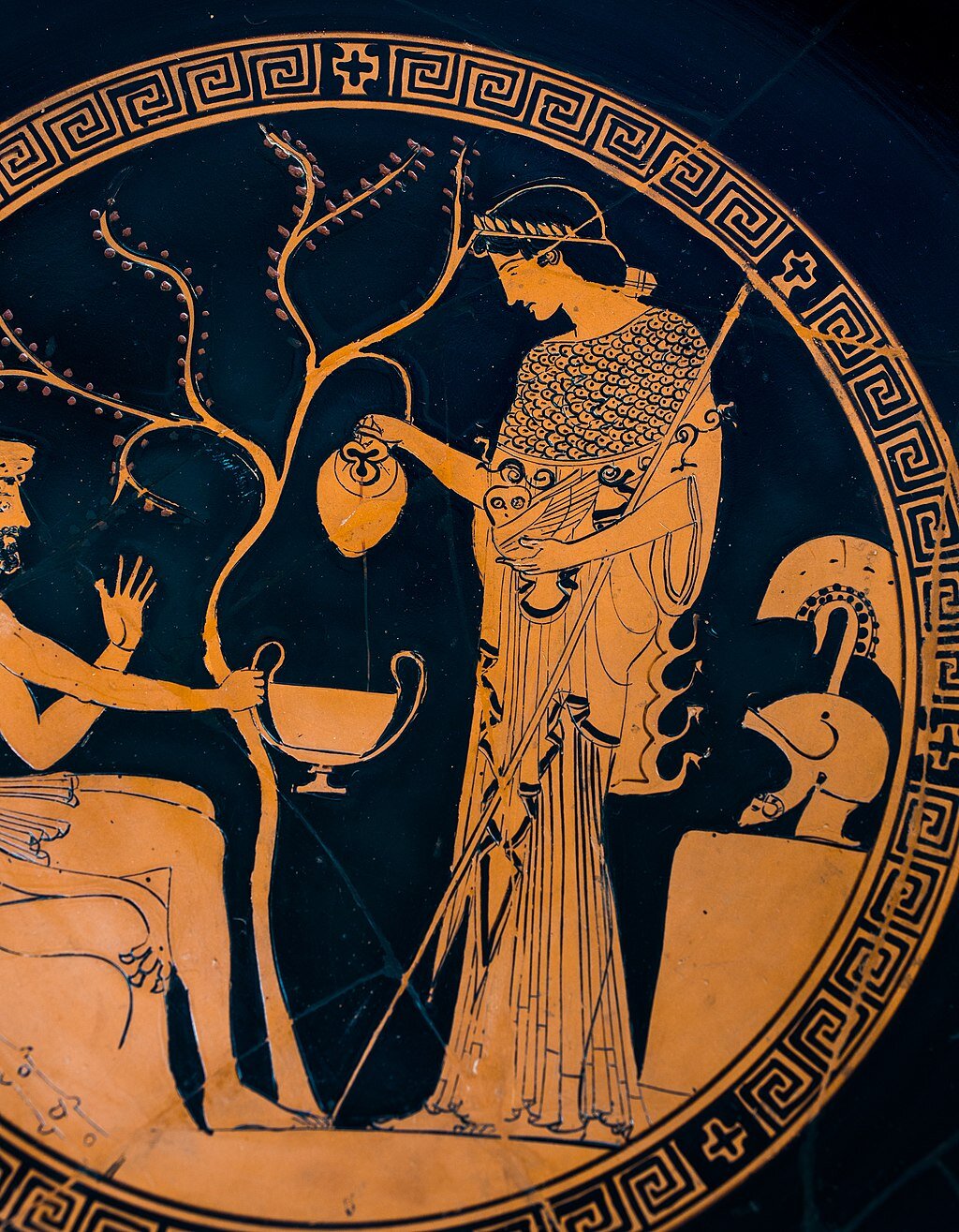
A painting on an ancient amphora of Athena pouring liquid into a cup with an Olive tree behind her. Photo Credit: ArchaiOptix via Wikimedia Commons CC BY-SA
For the ancient Greeks, the Olive was a sacred symbol of divine blessing and wisdom associated particularly with the goddess Athena, as well as with Zeus and the patron of human culture, Aristaeus. In this podcast episode, we discuss the ancient uses of the Olive, as well as discuss the Olive as a teacher of perspective and a reminder of the ancestral gifts of awe, gratitude and humility.
Listen below or with your favorite podcast provider
APPLE | SPOTIFY | Youtube | Amazon | DEEZER | PANDORA
Scroll down for show notes and the transcript.
Placing the Story
It is said that when Athena and Poseidon were seeking to make the region of Attica their own, they took part in a contest to see who would bear the best gift to the region. Athena’s offering of the Olive tree was voted to be a superior gift for humankind and so she became patron of the region’s city, naming it after herself (Athens) and planting that first Olive tree on its Acropolis, where her sacred temple, the Parthenon, was built.
Herakles planted Olive trees at Zeus’s sanctuary in Olympia, where he also established the Olympic Games.
Click the play button to interact with the map
One of my favorite museums in Greece is The Museum of the Olive and Greek Olive Oil in Sparta, where you can see amazing exhibits about the olive’s cultivation (including life-size replicas of the evolution of the oil press) and learn about the history of its use in medicine, cosmetics, religious ceremony, and cooking. Go here for more information.
A Devotion

Related Articles


Transcript
You're listening to A Temple Wild: Episode 6: Athena and the Gift of the Olive
Hello and welcome to A Temple Wild, where we rediscover the myths of the ancient Greeks through the plants and landscapes that shaped them.
My name is Ekstasy and it is a gorgeous day in early May here in Greece. It feels almost like summer, and while I was out in the garden this morning, soaking in the sunshine, I noticed that the Olive tree in our garden is actually covered in buds! And this is very exciting, because this particular tree was aggressively cut back several years ago by the previous owners, and last year it only produced one very small little olive. And we've been tending the tree now for two years and if the buds are any indication, I think the tree might actually really soon be covered in small white flowers which is really exciting. I'm hoping that means we're actually going to get some olives this year.
The Olive tree is an incredible evergreen: it's resilient, long-lived, slow-growing, and drought-tolerant, which means it's perfectly suited for Mediterranean climates. And despite over 5,000 years under human cultivation, the Olive still remains wild-looking and ancient, and some trees even surpass 1,000 or 2,000 years of age.
That blows my mind, that is absolutely incredible to think that a tree can survive over 2,000 years of life on this planet. It survives fires and drought, and even a complete cutting back to the stump, no matter what, it seems the olive tree just does not give up.
It typically is a shrub if it's left to its own devices, but in cultivation it is pruned into a tree shape to encourage flowering and fruiting. Their typically grown in groves; driving around Greece it's common to see very large tracts of land blanketed with that olive, silver-grey canopy. But they can also be grown as single trees, since most of them are self-fertilizing, which means that they do not need a partner tree, they don't need wind or pollinators in order to make their fruit and there are some varietal exceptions to that, but for the most part, they can be solitary trees. They can also be grown in containers; it's common to see small olives pruned into interesting topiary shapes, much like the Bay Laurel tree, which you might remember from another episode.
The Olive, though, is a formidable, primordial, and powerful tree, a teacher of perspective, after living 1,000 - 2,000 years of life on this Earth, how can you not have perspective, and it's a reminder to us of the ancestral gifts of awe, gratitude and humility.
It's associated particularly with the goddess Athena, as well as Zeus and also the patron of human culture, Aristaeus. It's a sacred symbol in ancient Greece of divine blessing and wisdom.
So I think the most famous story of the Olive tree is the one of Athena, who is a goddess of wisdom and wise counsel, of wartime, and also of weaving, which I think is interesting, weaving and other crafts such as pottery.
It is said that when she and Poseidon, who was the god of sea and earthquakes, when they both were seeking to make the region of Attica their own, to have patronage and responsibility over that region of Greece, they took part in a contest to see who could bear the best gift to the region. Poseidon struck the ground with his trident, bringing forth a rush of saltwater (in another version, he even also gave the first horse, the first war horse, to the region of Attica). But Athena, in response, instead, she struck the ground and offered the very first cultivated Olive tree.
Athena’s offering was voted to be a superior gift for humankind and so she became patron of the region’s city, naming it after herself (Athens) and then planting that first Olive tree on its Acropolis, where her sacred temple, the Parthenon, was then built.
The Olive branch, from then on, was thus included on coins from the ancient city of Athens, along with Athena's sacred animal, the owl, to denote her sacred patronage of the city. And as an origin story for the city of Athens, I think this points to the integral role the Olive played in Greek civilization and its perceived blessing upon humanity.
And indeed the Olive was a vital source of food, medicine, cosmetics, light, and religious importance for the ancient civilizations of the Mediterranean, including the Minoans and Mycenaeans.
Another story that features the Olive is that of Herakles - also known as Hercules. It is said by Pindar that when he arrived in Olympia at the
sanctuary of his father, Zeus, Herakles found it completely barren of trees and he felt a calling to go visit the land of the Hyperboreans and so it was there that he actually encountered the Olive tree and returned to Olympia to plant the trees at Zeus’s sanctuary, where he established the Olympic games in his father’s honor and the trees were there to provide cool shade for the athletes.
The ancient Greeks seemed to make a distinction between the cultivated olive, called elaia (ἐλαία) and the wild olive, called kotonos (κότινος). During the ancient Olympic games, the winner of each event would be crowned with a wreath of wild olive that had been ritually cut and woven from the sacred kotonos that were growing outside Zeus’ temple in Olympia.
That's how the olive branch thus became a sacred symbol of Zeus’s blessing and his protection, and Zeus himself was often depicted wearing crowns or half-wreaths of Olive.
And in yet even another association, the semi-divine figure Aristaeus is credited with gifting the practice of olive cultivation to humans, along with over crafts like beekeeping, herbcrafting, cheesemaking, and other rural or pastoral arts, like herding and foraging.
So one of my favorite museums in Greece is The Museum of the Olive and Greek Olive Oil in Sparta, where you can see amazing exhibits about the olive’s cultivation (including life-size replicas of the evolution of the oil press, which is actually really fascinating) and learn about the history of its use in medicine, cosmetics, religious ceremony, and cooking. If you're interested in more information about that Museum, I have a link in the show notes so if you're planning a trip to Greece anytime soon, you can check out that Museum; it's definitely worth a stop.
So both olive oil and olives were a foundational part of the ancient Mediterranean diet. The leaves were also used as a medicinal tea and wash for various ailments. And wood from the tree was carved into sacred figurines, as well as used for household tools and construction.
But it was the oil, in particular, that was prized for its many uses as a source of body care, of light, of blessing, and of religious ceremony. As a base for perfume or salve, the oil was applied as a topical moisturizer and cleanser for the body and hair. (Ancient art depicts that bathing Greeks, as well as athletes, would apply the oil onto their bodies and then scrape it off using a special, curved tool called a strigil that would remove dirt and sweat from the body.) The oil was also burned in terracotta lamps and torches as a source of light. And it was used to bless sacred statues, applied to anoint leaders and supplicants, and it was poured on the ground in offering to both the gods and the ancestors.
So one of the things I find amazing about the Olive tree is to just reflect upon the thousands of years, the hundreds of years, that each tree has witnessed in its life. It has seen the life-death cycles of countless other species, other plants, other insects, humans who have come and gone in its presence, and I just wonder what kind of wisdom that type of life, that length of life can bring into your being. Especially being grounded in place, as it is, and seeing so many seasons in one place.
And I really like to call upon that wisdom and reflect on the sacred perspective that the Olive tree can give us and its connection to our ancestry. We have had a relationship with this tree for over 5,000 years, and I think within its stories is the story of our human experience. We share the oil in meals, we use it to adorn and bless our bodies, we used to use it as sacred light and of course as medicine.
And while you might think that the Olive, because it is associated with a goddess of war, Athena, or with Zeus, you would think that maybe the Olive tree would be a symbol of victory or of triumph. But for the ancients, nothing was done by human power alone; they really had an understanding of our connection with Nature. For them, triumph was a blessing of the gods or perhaps an intervention from the forces of fate but for that reason, I really think the Olive crown, and the Olive in general, is really a symbol of divine blessing: the winner of the Olympic games didn't win from personal and human skill alone, and definitely not by chance, but because the gods and the forces of Nature had decided to aid them in their challenge.
And as each major story associated with the Olive - that of Athena, Herakles, Zeus, and Aristaeus - emphasizes the gift of the Olive and its blessings bestowed upon human culture. To me, the Olive is really a potent teacher wisdom, ancestral gifts and divine blessing.
To me, this idea of being blessed, or thinking of life as a gift, is a state of mind. It's the opposite of taking something for granted; it is not about having earned it or being owed something. It is more about the ability to bow in humility at the fleeting nature of our lives, but also to rise up in gratitude to the Mysterious force of Nature and the mysterious life that we are living.
Being blessed is a state of awe and wonder at the complexity of our experience.
So this idea of Divine Awe and gratitude it's a challenge. It is particularly difficult, I think, in times of illness or chronic pain, when we're going through grief and loss or failure. And it is easier to feel gratitude and it's easier to feel blessed when we're in times of abundance, in times of health, joy, and connection. Everything feels so personal all the time, whether things are good or things are bad, it feels like a personal attack on you. You are either being rewarded or you're being punished.
But I think something that the Olive reminds me is that there is no thought, there's no emotion, there's no sensation that someone, somewhere, has not already had. In fact, it’s actually really likely that right now, hundreds, if not thousands or even millions of other human beings are thinking and feeling the exact same thing that you are. And if they are not, then at some point in the past or at some moment in the future, they will.
This is the wisdom, for me, of the Olive: the gift of our ancestry, the divine blessing of perspective that there is nothing really new to our human experience, and yet everything is fresh every moment because we are experiencing it right now.
Our life is something granted to us from our ancestors. It's terribly beautiful, wonderfully awful, sometimes even really boring. And so when we lose our perspective, when everything feels personal, when we find ourselves stuck in a loop of grandiosity - maybe thinking, "Oh I'm the most important thing in the Universe; I'm so blessed and important to the gods and the forces of Nature" - or if we're on the opposite of that and we're stuck in the loop of insignificance where our life doesn't matter and we're absolutely nothing in the face of time and all of Nature - I think the Olive can be called on as a teacher of wisdom, humility, and ancestral connection, and perspective to just help us remember our place in the web of life.
So translating that into an actual practice, find yourself an Olive tree, whether it's in your native lands if you're here in the Mediterranean or if you happen to live somewhere you can grow an Olive in your garden or inside in a very sunny corner of your house, and just reflect on the stories that several hundreds of years would impart on such a being.
I encourage your to just let the wisdom of the Olive and its shared history with our species whisper to you the wisdom of the ages.
I have a little devotion that I sometimes like to say,
Blessed Olive, Keeper of Wisdom,
teach me divine perspective
so that I may know humility,
awe, and wonder,
and rise with dignity
to this daily challenge of being human.
I want to thank you so much for listening today. A Temple Wild is totally funded by your support. So if you're passionate about Greek mythology, plant lore, and the incredible Mediterranean landscape, I'd really love to have you join our community as a patron! With your support, I'm able to afford the tools and the time it takes to create and write, record and edit, and publish these stories from the land.
For those of you already supporting the show, thank you so much: it's really you who keeps A Temple Wild live on the web and I'm so grateful that you're joining me on this journey into the Mythic Greek landscape.
If you too would like to become a patron, head on over to atemplewild.com for more details. While you're there, you can also sign up to the monthly newsletter, send me a personal message, or even leave a one-time tip in the tip jar if you're not able to become a regular supporter at this time.
I thank you again so much for listening today; I hope you have a wonderful day and I will see you next time.