Poplar

Poplar forest. Photograph by Dariusz Kowalczyk, CC BY-SA 4.0 via Wikimedia Commons
Populus spp.
Underworld — Source — Paradox
The Poplar is a fast-growing, deciduous tree in the Willow family found near freshwater rivers and streams. Sacred to Hades, as well as to Herakles and his father, Zeus, in relation to the hero’s success in an Underworld trial, the Poplar is said to grow at the entrance to the Realm of the Dead. Not only tied to death, the Poplar is also connected to many stories of metamorphosis and freshwater, particularly the nymph Leuke and the grieving Heliades. With ghostly bark — whether white or black or both — this liminal tree indicates the location of life-giving waters, while also appearing burnt or parched. Able to survive both flood and drought, the Poplar reminds us to seek the Source: to reach deep to the flow of groundwater that nourishes the root of being. Keep reading below below to learn more about the Poplar.
Index
The Poplar in the Wild & Garden

Black Poplar (Populus nigra)
LATIN BINOMIAL
Populus spp. The genus consists of many species, including the Cottonwood and Aspen. The two main Poplar species in Greece are P. alba (White Poplar) and P. nigra (Black Poplar)
PLANT FAMILY
Salicaceae
COMMON ENGLISH NAMES
Cottonwood (Populus spp.), White Poplar (P. alba), Black Poplar (P. nigra), Lombardy Poplar (P. nigra)
COMMON GREEK NAMES
Λεύκα (Populus spp., P. alba), Αιγείρα (P. nigra), Λεύκη μαύρη (P. nigra)
CHARACTERISTICS
Fast-growing deciduous, dioecious tree in the Willow family found in forests and along freshwater sources. Generally a short-lived tree (50 years), but can live 300-400 years.
NATIVE HABITAT
Northern hemisphere
PREFERRED CLIMATE & CONDITIONS
Prefers watersides and bright, direct sun up to 800 meters above sea level without frost damage (Hardiness Zone 9). Adaptable to various water conditions, including drought and periodic flooding. Prefers moist and alluvial soil, but will grow in heavy clay. P. nigra (Black Poplar) cannot tolerate maritime exposure, while P. alba (White Poplar) can handle the salt-laden winds that come off the Mediterranean sea.
TYPICAL HEIGHT AND SPREAD
Varies, depending on species. P. alba (White Poplar) grows up to 20 meters (65 feet) with a girth of 12 meters (39 feet). P. nigra (Black Poplar) grows up to 30 meters (98 feet) with a girth of 20 meters (65 feet). Can grow 1-1.5 meters (3-5 feet) each year.
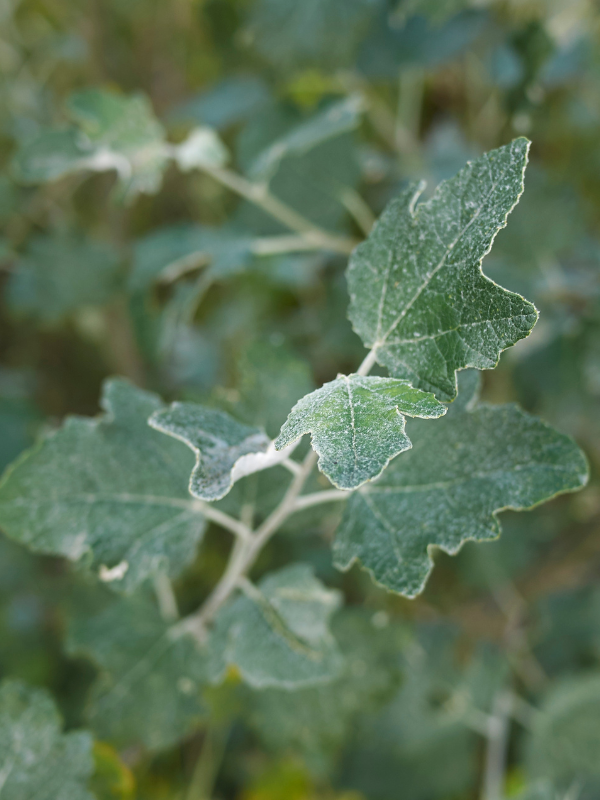
White Poplar (Populus alba)
Trunk, LEAF and Bloom CHARACTER
P. alba (White Poplar) leaves have shiny, dark-green upper surface with white hair on the bottom surface. Trunk typically leans to the side (not straight) and bark is easily identified by its grey-white, smooth surface with black diamond fissures on younger growth; older bark darkens and fissures as it ages.
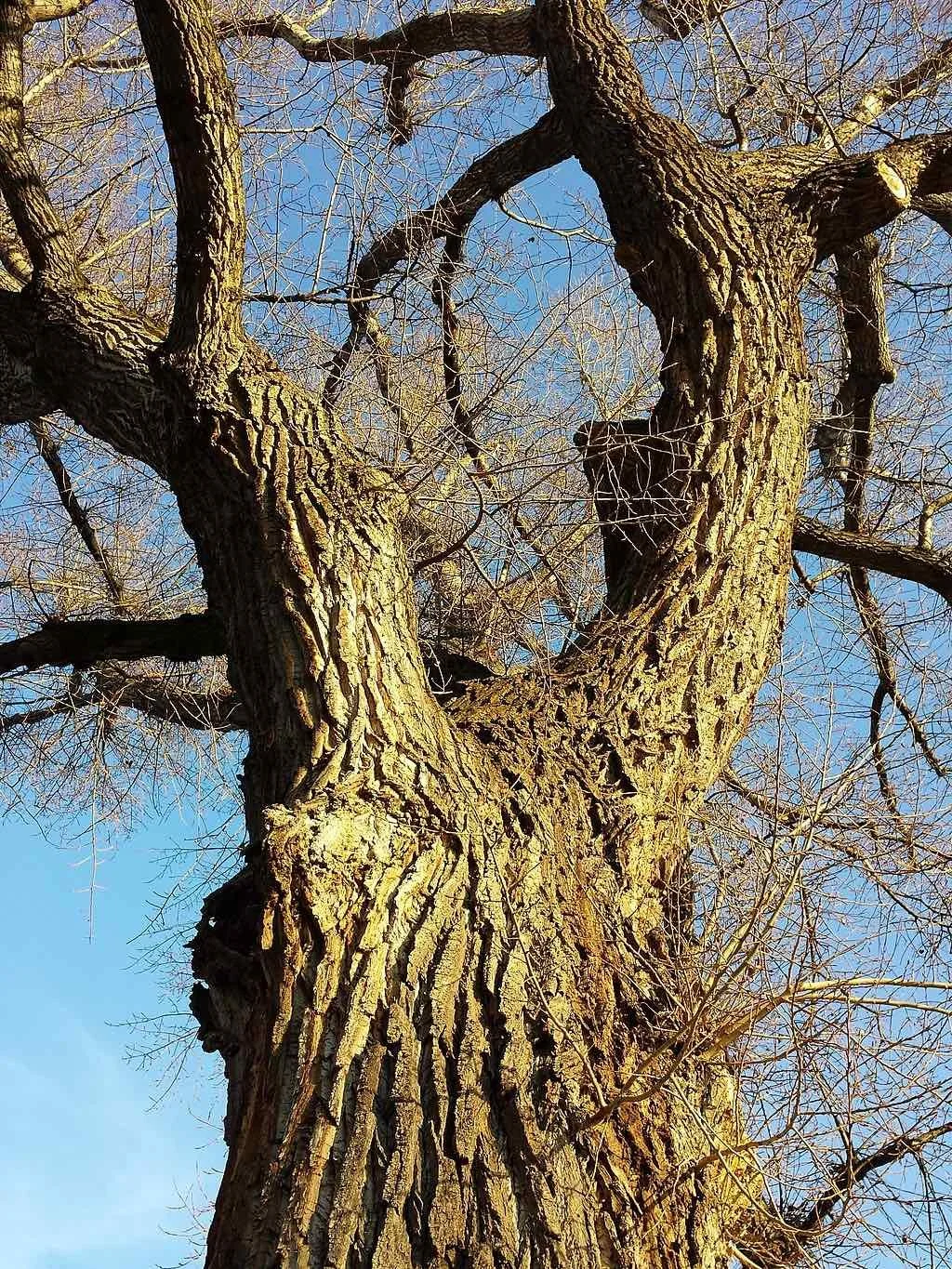
P. nigra (Black Poplar) leaves are glossy, dark green, and gently triangular, with serrated margins. Buds are resinous and aromatic. The trunk has a fissured dark brown, black, or grey bark. Grows in a columnar shape, making it popular for landscaping borders and windbreaks.
Both trees are dioecious (meaning male and female flowers are on separate trees) and flower before leafing in early spring; they produce drooping catkins that attract bees and other pollinators. Female catkins are a yellow-green; male catkins are red. The catkins mature into green drupes that erupt into fluffy seeds in early summer. The buds and seeds are a food source for many animals.
Care In the Garden
In the wild, trees propagate seeds via wind- and water-dispersal (when the white, fluffy seeds disperse it can look like snow or ash on the wind), but in the garden it’s easiest to propagate via mature wood cuttings in early winter or via suckers in spring. Because the seeds are often seen as “messy,” male Poplar trees are more commonly found in cultivation (and in some parts of the world, like the UK, the Black Poplar is endangered because most female trees have been cut down and the wild male trees are most likely to pollinate cultivated varieties). Extensive root system can be drying to the soil and damaging to building foundations; plant at a distance from any hardscaping or buildings. Tolerant of hard pruning. Vulnerable to fungus, cankers, and blight.


The Poplar in Greek Mythology

Leuke & the Tree of Hades
The Poplar is first and foremost a tree sacred to the Underworld.
Leuke (whose name means “white”) was a beautiful nymph who was brought to the Underworld by the god Hades. Being mortal, Leuke could not survive in the Land of the Dead and was instead transformed into a White Poplar tree. (Some say the tree still grows there, one of the few living trees to thrive in the Underworld.)
According to Homer, the Poplar grows with Willow in Persephone’s groves at the threshold to Hades’ realm. The White Poplar grows abundantly along the Acheron River, which was considered the entrance to the Underworld, where Charon would ferry souls to Hades. (The Acheron River is also the site of the ancient Oracle of Necromanteion in Thesprotia, Epirus, Western Greece.)
“...where is a level shore and the groves of Persephone—tall poplars, and willows that shed their fruit—there do thou beach thy ship by the deep eddying Oceanus, but go thyself to the dank house of Hades. There into Acheron flow Periphlegethon and Cocytus, which is a branch of the water of the Styx; and there is a rock, and the meeting place of the two roaring rivers.””
HerakleS and Zeus
To accomplish his twelfth and final task of atonement for the murder of his children, Herakles entered the Underworld and subdued its guard-dog, Cerberus. In victory, Herakles adorned his head with a wreath of the White Poplar (harvested either from along the Acheron River or from the Underworld tree itself). Those who later offered sacrifices to the hero would similarly crown themselves with Poplar.
When Herakles later went to Olympia to burn a sacrifice to his father, Zeus, he used the wood of White Poplar, thus establishing it as the sacrificial wood at Olympia. It’s also said that when Herakles established the Olympic Games, he introduced the Poplar — along with the Olive — as a tree for shade. Victors of the Games would sometimes adorn themselves with White Poplar wreaths.
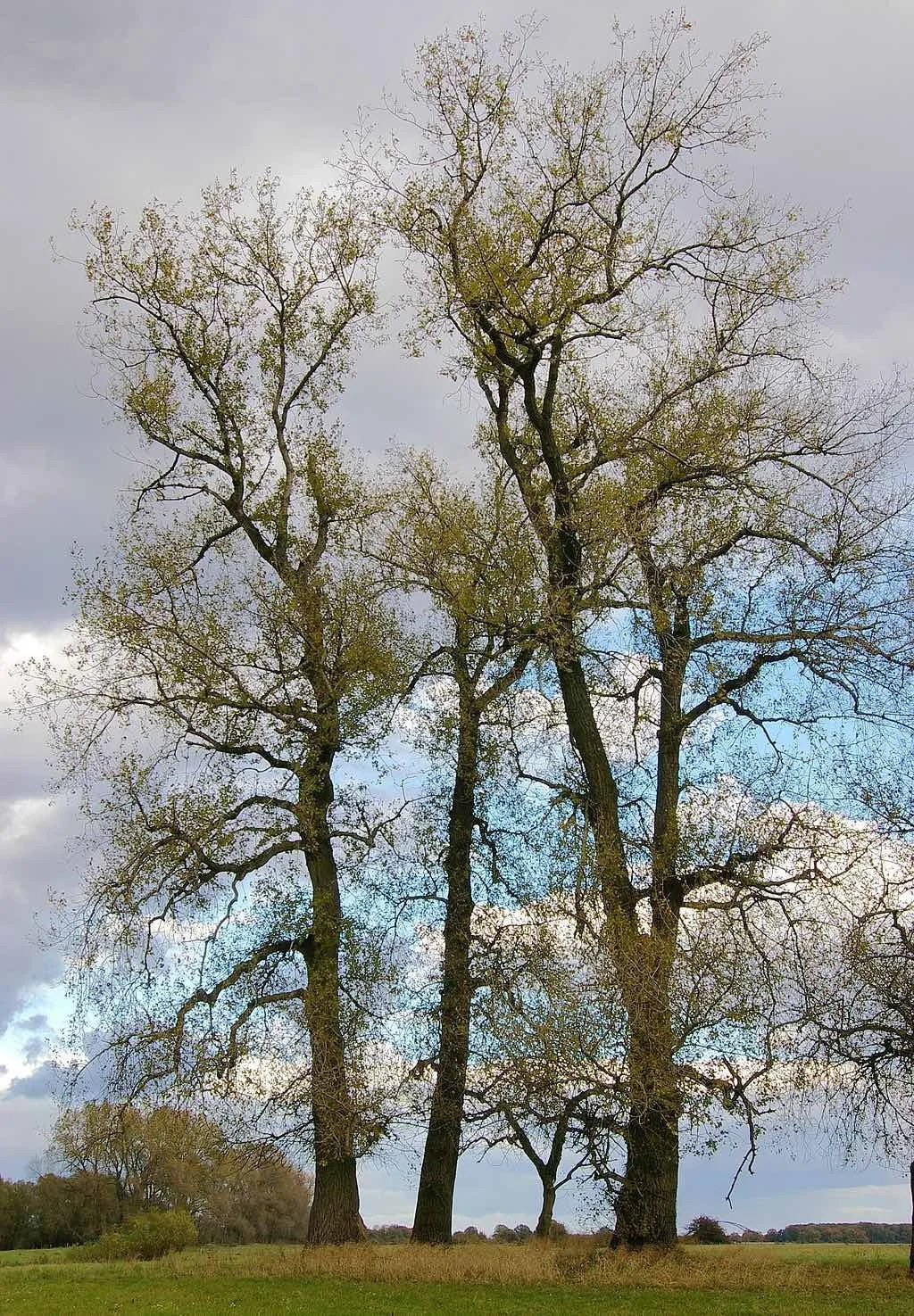
Populus nigra, photograph by Christian Fischer, CC BY-SA 3.0, via Wikimedia Commons
Dionysos
Wreaths of Poplar were also worn by worshippers of Dionysos in his Chthonic form.
The Heliades
In yet another story linking the Poplar to the dead, Phaethon was the child of the sun-god Helios. Wanting to prove himself to his father, Phaethon convinced Helios to let him drive his Sun-Chariot across the sky. But Phaethon was young and inexperienced and could not control the horses. He would either drive too close to the earth — scorching its surface — or too far away — freezing the earth. The other celestial beings called out to Zeus to put a stop to Phaethon’s ride, and so the God of the Sky struck Phaethon with a thunderbolt. Phaethon died, tumbling from his father’s Sun-chariot and into the Eridanos River.
Phaethon’s sisters, the Heliades, grieved him deeply. Standing beside the river, they were transformed (either by time or by Zeus himself) into Black Poplar trees and their tears became amber, falling into the water.
Nymphs, MEtamorphosis & Water
The Poplar is connected to many stories of nymphs, metamorphosis, and water. First is Leuke, the nymph who was transformed into a White Poplar in the Underworld and whose tree marks the entrance to the Realm of the Dead along the Acheron River. The Heliades (daughters of the sun god Helios) were transformed into Black Poplars along the Eridanos River. Dryope — seduced by Apollo and the mother of Amphissos — was transformed by the Hamadryads into a Poplar, beside which they also formed a freshwater spring. There are also the Sperkheides — who were Naiads (freshwater nymphs) that were transformed into Poplars by Poseidon so he could seduce their sister. And finally, when the Argonauts encounter the Hesperides (the three nymphs of evening light who guard Hera’s Golden Apple tree) and the men plea for a source of water, each of the three nymphs transform into a tree (a Poplar, an Elm, and a Willow) so they can point the thirsty travelers to a spring.
“They caused grass to spring from the earth; and above the grass rose up tall shoots, and then flourishing saplings grew standing upright far above the earth. Hespere became a poplar and Eretheis an elm, and Aegle a willow’s sacred trunk. And forth from these trees their forms looked out, as clear as they were before...and Aegle spake with gentle words.”
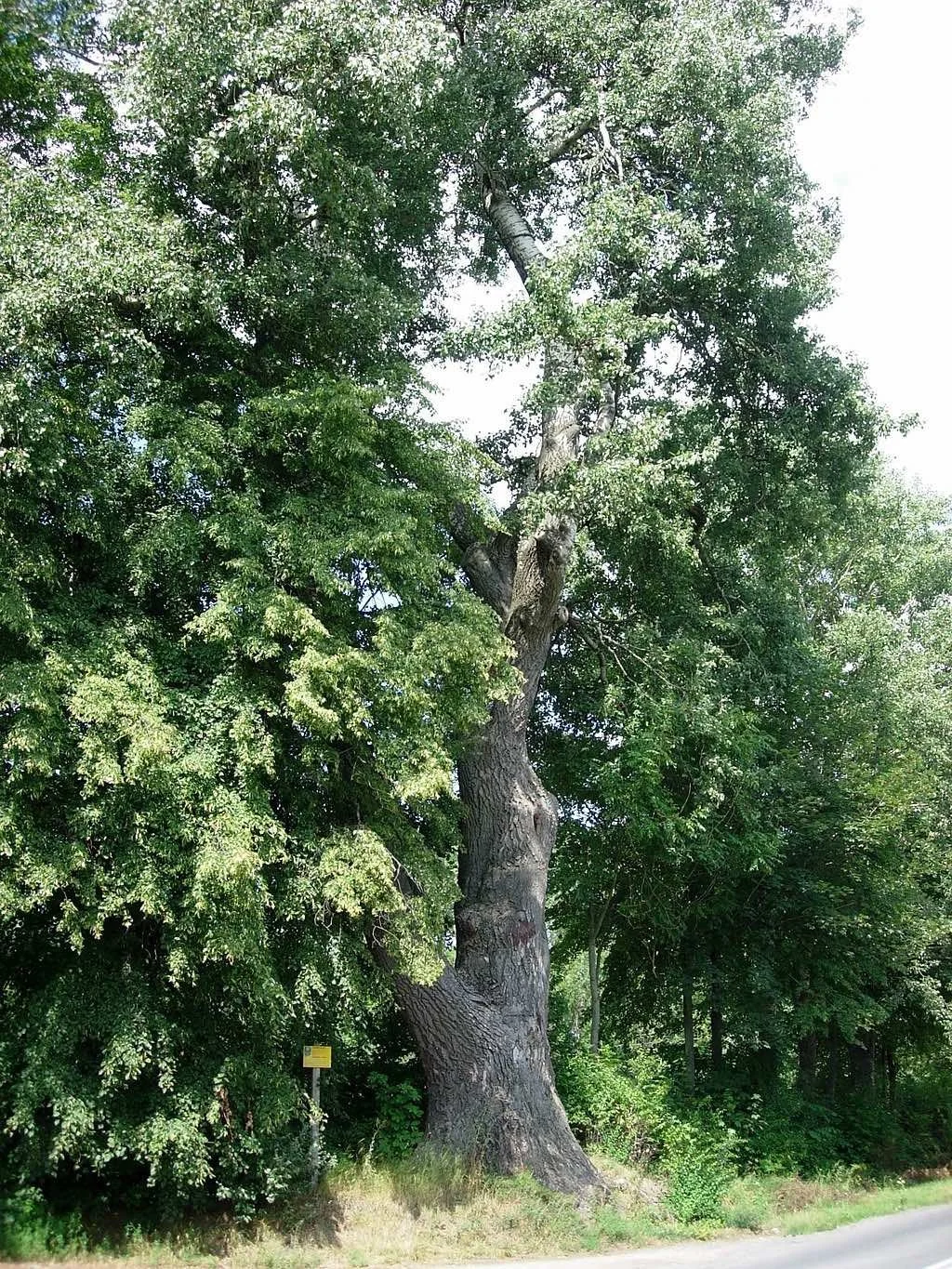
Populus alba. Photograph by Jakubhal, CC BY-SA 3.0 via Wikimedia Commons
Aigeiros, The Hamadryad
The Dryads are nymphs who nurture, protect, and embody the essence of trees. Their health and vitality is wholly dependent on the health and vitality of the tree with which they share a symbiosis. As shared above, Leuke was the nymph of the White Poplar, loved by Hades. According to Atheneaus, the nymph of the Black Poplar was the Hamadryad named Aigeiros.
For more guidance in connecting with the Dryads, I invite you to explore this guide.
Back to top
The Poplar in Ceremony
Underworld — Source — Paradox

The Poplar is a Chthonic being, a powerful ally in our practice of Descent. Like all Chthonic plants, it calls on us to honor the Underworld — the dark, fertile soil from which all life grows and to which all life returns in death. Able to survive both flood and drought, the Poplar reminds us to seek the Source: to reach deep to the flow of groundwater that nourishes the root of being. With ghostly bark — whether white or black or both — the Poplar is a liminal tree that indicates the location of life-giving waters, while also appearing somehow burnt or parched. The White Poplar, especially — with its leaves fertile-green on one side and bone-white on the other — shows us this paradox in its essence. And the fluffy white seeds which disperse in summer look like snow or ash on the wind.
In Greek myth, the origins of both the White Poplar and the Black Poplar are tied to death, but also to freshwater rivers and springs. Leuke, the nymph who was transformed into a White Poplar, was loved by Hades, god of the Underworld. Her tree grew within the Realm of the Dead and became sacred to Herakles and his father, Zeus, in relation to the hero’s success in an Underworld trial.
When Phaethon rode in his father’s chariot, his erratic driving threatened the earth with both fire and frost, but his death by thunderbolt restored the balance. Phaethon’s sisters the Heliades, though they grieved him, were transformed into Black Poplars and stood sentinel beside the river where he died.
Black and white, hydrated and parched, fertile and sterile: the Poplar holds polarity with ease.
It may seem strange that such a life-giving force — water — would also be so connected to the Realm of the Dead. However, we absolutely need water to survive. That may seem obvious, but in a Mediterranean climate – where long, dry, hot summers result in a prolonged drought season — water takes on an even more vital role. When the rains stop and the earth is parched, it is like a second winter: many plants die back or hibernate, streams evaporate and lessen their flow (or even run dry), and animals, including humans, must seek freshwater at a large river or natural spring. Trees that signal the location of ample freshwater, such as the Poplar, have particular significance as they indicate a source of life in a desiccated landscape.
Let us also remember that both the Realm of the Dead and the god himself are called “Hades” (meaning “Unseen”) and they are both underground. Rivers, and especially springs where water bubbles up miraculously from unseen sources, are portals to that Unseen Realm. And the Poplar, standing sentinel at the water’s edge, is a guardian of such an entrance. Indeed, in Greek myth, the Poplar is believed to grow at the entrance to the Underworld, particularly along the mighty Acheron River.
Like the Asphodel, the Poplar is a liminal plant: it exists on the borders. But while the Asphodel is an ally for traversing or traveling across those borders, the Poplar reminds us to descend and stay connected to Source.
Parts Used
stem, bark, leaf buds, leaves, fruits
Safety
Generally considered safe to use, but avoid if allergic to salicylate (aspirin), and avoid internal use if pregnant or nursing. Note: There are other trees with the common name “Poplar,” such as the Tulip Poplar (Liriodendron tulipifera), which do not belong to the Poplar (Populus) genus. Please be sure to positively identify the tree with which you are working.
Elemental Correspondence
Seasonal Celebrations
Altar
Buds of the Black Poplar are intensely aromatic and sticky with healing resin; collect or harvest in late winter or early spring and infuse them in olive oil to create an anointing oil. Craft a crown and adorn yourself or your altar with White Poplar leaves to reflect on the paradox of Hades.
Ceremony
When feeling depleted, disconnected, or as if your well has “run dry,” call upon the Poplar to teach you the wisdom of rooting into Source and drawing upon the Wellspring that sustains all things. Reflect on the Chthonic paradox — the deep-green of fertility and the bone-white of sterility or death — and how both states are two sides to the same coin. Unlike Phaethon — who tried to take on too much responsibility when he was not prepared, resulting in alternating drought and frost — we can seek balance between polarity and root into sourcewaters. Like Herakles entering the Underworld and returning with a Poplar crown, we can descend down through our roots to tap into underground currents and draw up sustenance and strength from the Wellspring of being.
Devotion
Whether before your altar or the living tree, read the following:
Poplar, bone-white,
Poplar, fertile-black,
water-seeking, water-sourcing,
show me how to root down
to the Wellspring of being.
For more in connecting with the Dryads — the nymphs of the Poplar and other trees — I invite you to explore this guide.
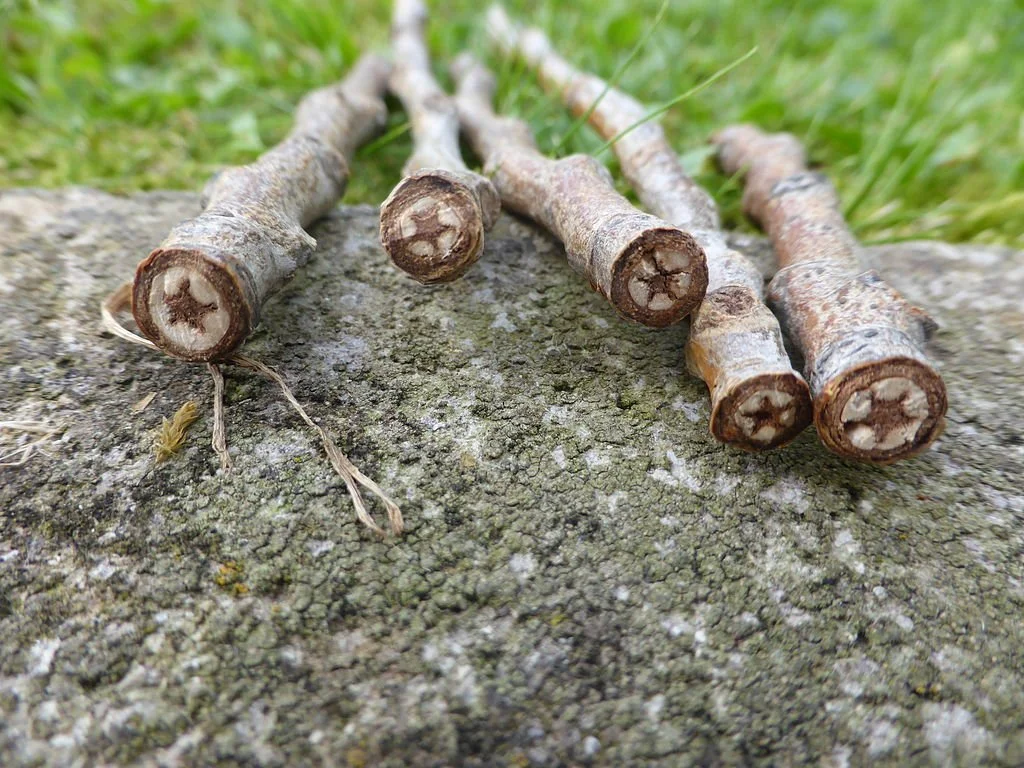
Black Poplar (Populus nigra). Photograph by Giulio1996Cordignano, CC BY-SA 4.0 via Wikimedia Commons
The Poplar in the Kitchen & Apothecary
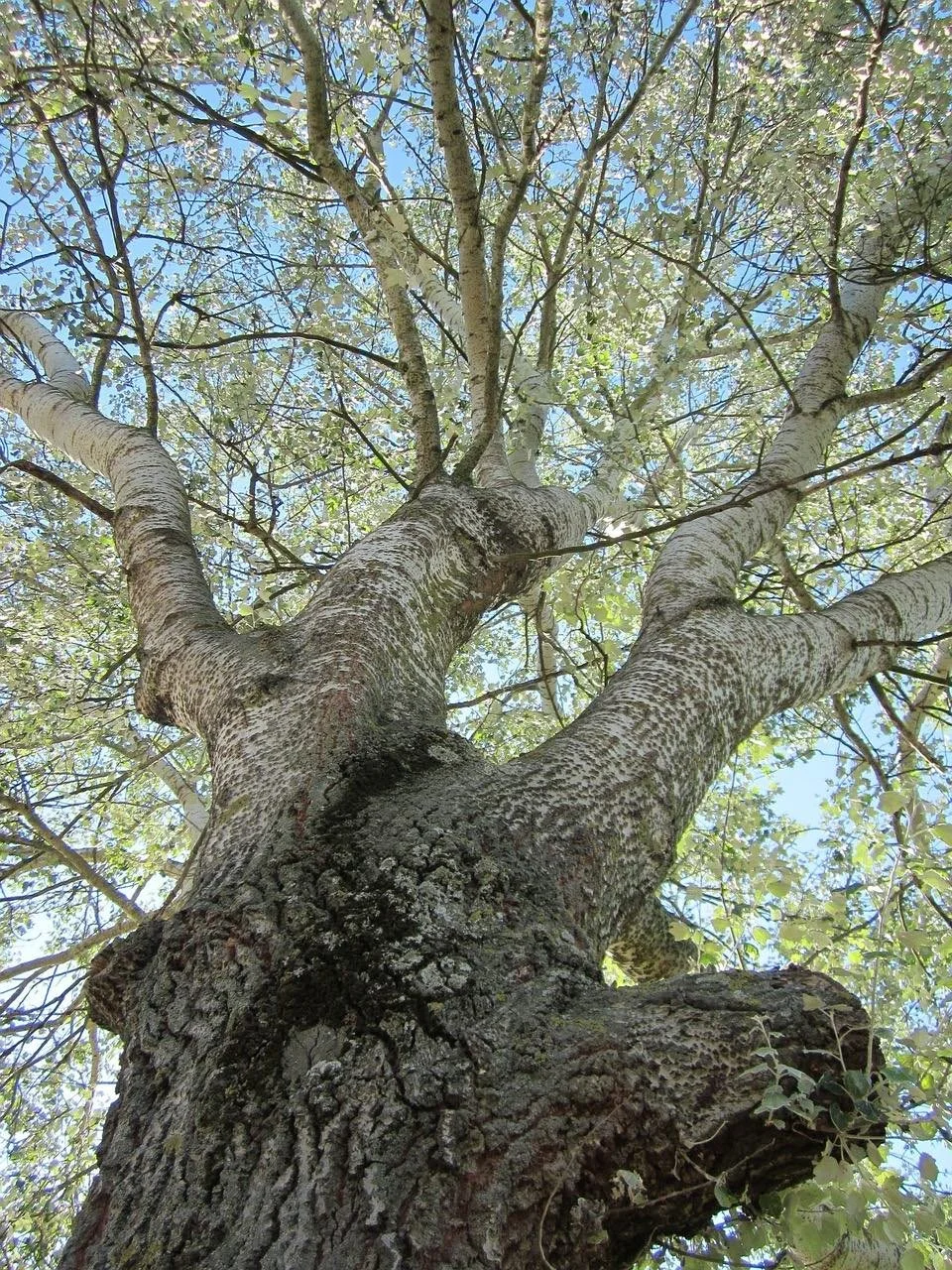
Parts Used
buds, inner bark, leaves
Traditional Medicinal Applications
The buds of many Populus spp. are thick with aromatic resin which has antimicrobial, antifungal, and analgesic properties. Like other trees of the Salicaceae (Willow) family of plants, the Populus spp. contains salicylate (from which aspirin is derived).
The resinous buds can thus be harvested in end of winter or early spring, then infused in oil to make topical oils, salves, and creams for the treatment of rheumatic pain, bruises, and sore or strained muscles, as well as for the treatment of various skin conditions, such as wounds, bites, or rashes. Internally, a tincture of the buds has been traditionally used as a warming, stimulating expectorant or bitter digestive-aid.
Culinary Flavor and Use
Not typically consumed by humans, the inner bark is considered a famine food and can be ground and added to flour for bread. The P. alba (White Poplar) leaves are rich in Vitamin C.
Other Traditions
Poplar extracts (made by soaking chopped branches and shoots in water) can be used as a rooting hormone for many types of propagation cuttings.
Safety and Drug Interactions
Generally considered safe to use, but avoid if allergic to salicylate (aspirin), and avoid internal use if pregnant or nursing. Note: There are other trees with the common name “Poplar,” such as the Tulip Poplar (Liriodendron tulipifera), which do not belong to the Poplar (Populus) genus. Please be sure to positively identify the tree with which you are working.