Do Greek Forests Need Wildfire?
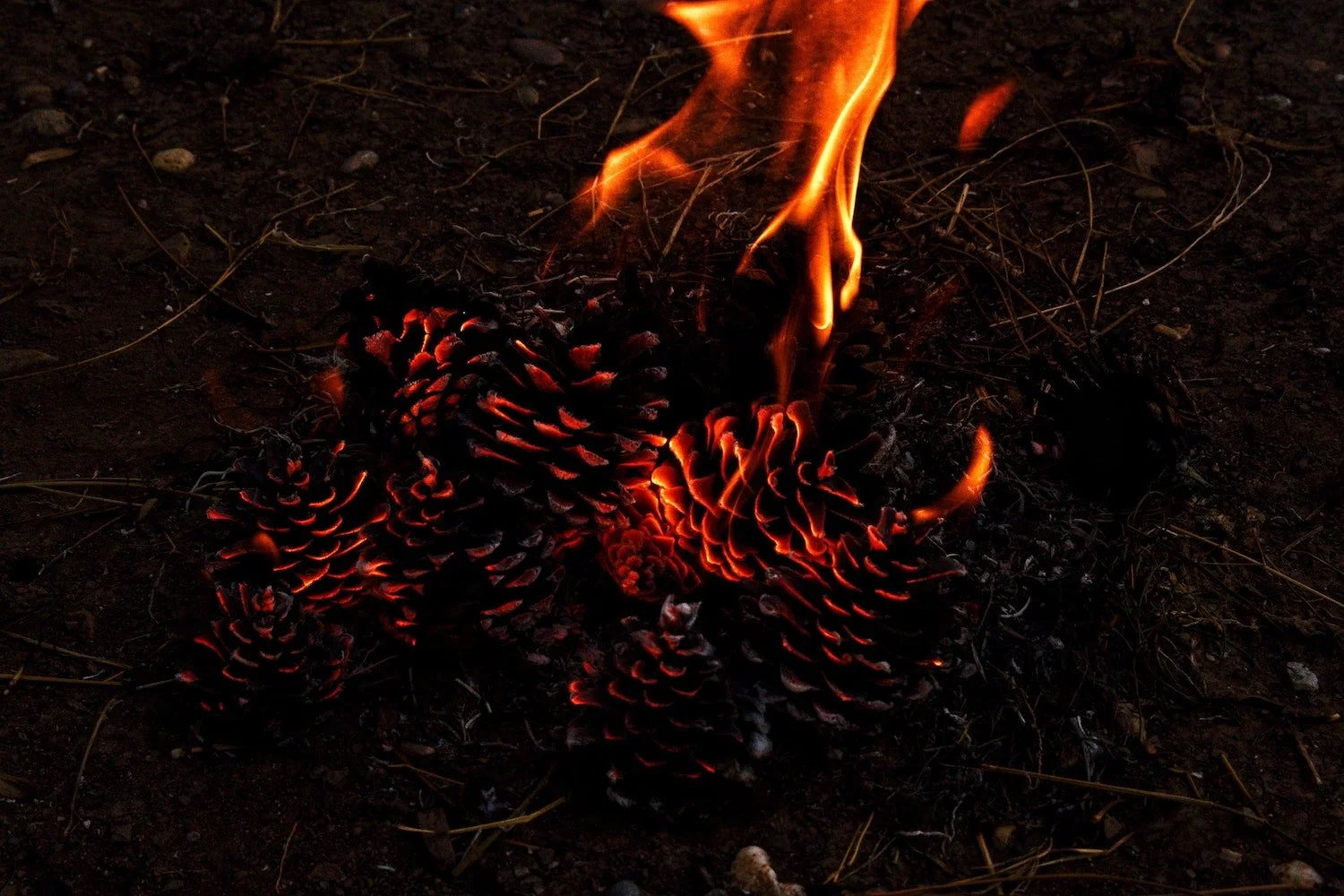
In the summer of 2021, in two weeks alone, wildfires burned over 100,000 hectares of land across Greece, including the island of Evia, areas of Attica, the Peloponnese, and northern Greece. Aerial footage of the destruction is heartbreaking: acres of burnt trees, parched ground, devastated communities of humans, wildlife, plantlife, and insects. The long-term effects of the fires go beyond the immediate devastation: erosion causing topsoil degradation and landslides, loss of tree life contributing to increase in temperature and decrease in oxygen production, not to mention the toll it takes on human, animal, and insect communities who rely on the forest for their livelihood and well-being.
Wildfires of this magnitude seem to be, from the research I’ve been doing, completely avoidable. But are all wildfires "bad"?
Wildfires start from the coming together of biofuel (dried plant material) and a spark or flame. Sources of a spark or flame are most often from lightning strikes, volcanic eruptions, or human behavior, whether intentional or accidental (like discarded cigarette butts, unattended campfires, machine sparks or malfunctions, and arson, to name a few).
Despite what you might think, high temperatures alone are not the cause of wildfires, though there is a correlation. The greatest force to set the stage for fire is drought, which of course can be exacerbated by high temperatures. But trees and plants hold water in their roots, limbs, and leaves; if the landscape is effectively moist, it’s not necessarily high temperatures that will start a wildfire. It’s when the lack of rainfall leaves the landscape parched — and high temps contribute to an increase in water evaporation (as is common during a Mediterranean summer) — that we see the correlation between heat and fires.
Biofuel (dried plant matter) accumulation is common in Greek Pine forests, where an understory of primarily evergreen brush and herbaceous plants easily turn dry in the Mediterranean summer heat. Add to that the fallen Pine needles and it’s a perfect recipe for highly flammable tinder.
Pine trees that are tapped by humans for their resin — with dripping gum wounds and droppings — become like upside down fuses, easily transporting a ground fire from the understory up into the crown of the tree and spreading it across the forest canopy. And if it’s windy, the air will help it travel, fanning the flames and growing the fire.
In recent history, many governments have had a policy of “fire suppression” — tactics and approaches used to prevent and stop wildfires from even starting — with a primary focus on saving human lives and human material goods.
In the 2021 Greek wildfires, “the current government’s greatest concern was that there would be no loss of human life, a resolution adopted from the tragedy of the fire in Mati in 2018 when 103 people lost their lives”(1). But this meant that in 2021, efforts were centered around evacuation, rather than using the “equipment, coordination and surveillance methods” necessary for containing the fire before it could spread to its devastating proportions (2). The Greek government has thus been criticized for its slow response rate, as well as its relatively recent changes in policy, which no longer involve local forest experts (such as foresters, beekeepers, loggers, and resin collectors) who might have first-hand knowledge of — as well as a personal investment in — maintaining the health of their forests.
In landscapes like the Mediterranean, fire suppression tactics may actually be exacerbating the problem.
Some forests need fire in order to thrive, and small, contained fires — those that stay on the forest floor and do not travel up into the canopy — can assist in clearing out dead plant matter, increase seed germination for some plant species, and aid in regenerating the soil.
If dried plant matter is not cleared from the forest floor — either by wildfire or by human removal — then the biofuel accumulates, essentially creating a greater pile of tinder and increasing the risk for massive fires that spread into the upper canopy. Today, the forested regions of Greece are at a greater risk of wildfire due in large part to socioeconomic factors: people are leaving the villages and agricultural communities and moving to cities, resulting in land abandonment — which increases the accumulation of bio-fuel since there’s no one there to tend the landscape.
Learning all of this, I became interested in what some people call “prescribed burning” or “controlled burning.”
Essentially, this is the intentional burning of the landscape by humans in small and defined areas as a means for managing biofuel load (in other words, removing dried plant matter), regenerating the soil, stimulating seed germination, and effectively reducing the risk of massive, upper canopy fires. And there’s a long history of this in indigenous cultures of western north America, Australasia, and sourthern Europe, including the French Pyrenees, where cultural, intentional burning is a vital aspect of human interdependence with the land.
But not every forest needs or wants Fire.
There are many factors that go into a forest’s desire for burning: what plant species are growing there and its soil chemistry. Essentially, it’s important to understand the local ecology of each particular forest. (For example, what works for northern California does not work for southern California, though both areas experience wildfire). But according to L. G. Liacos of the School of Agriculture and Forestry at the Aristotelion University of Thessaloniki, there is strong evidence that prescribed burning may be “indicated and valuable” in Greek ecosystem management of grasslands of the high mountains, of maquis (shrubland), and of the Pine forests of Pinus halepensis and P. brutia (3).
But there is a difference between prescribed burning done by those who have ancestral and/or landscape-informed knowledge on how to properly burn for forest health— and the uninformed, haphazard burning used for land clearing and deforestation projects.
Today, farmers often practice (improper) burning in order to increase land available for grazing and farming, often with a negative impact on the land and soil health. There is also a long history in Greece of arson — practiced by both individuals and private companies (or even rumored government officials) — in order to clear land for housing developments and the building of public infrastructures (such as wind turbines). As urban settlements expand, it’s more important than ever to seek appropriate land management techniques that protect the health of Greek forests — not only because we as humans rely directly on them for oxygen, food, heat, and shelter — but because they are an integral part of the Mediterranean’s overall vitality as an ecosystem.
Did the ancient Greeks use fire as a means of land management and forest regeneration?
That is the question that got me stumbling down this rabbit hole in the first place and, to be honest, I could not find a definitive answer. It’s theorized that the ancient Greek peninsula was in fact once blanketed in forests of Pine (Pinus halepensis, P. brutia, P. Pinea) and evergreen Oak (Quercus ilex). But most of that is now low scrubland of small evergreen shrubs and herbaceous plants due to the forest management practices that were started by the early settlers of the Greek peninsula and continued to this day: logging (for firewood and building materials), intentional burning (to clear the land for animal grazing and agriculture), over-grazing by sheep and goats, and wildfires, as well as the erosion that all of those practices and events cause.
But in my (admittedly brief) research, I didn’t find ancient Greek evidence of the kind of prescribed or cultural burning practiced today by many of the world’s indigenous communities for forest health management. To the contrary, it seems that the ancient Greeks — at least those with the power, tools, and means to do so — were practicing unsustainable forest management techniques in the name of agriculture, war, and human expansion.
Forest health — and the history of forestry in Greece — is a massive topic, and I’ve admittedly barely even scratched the surface. But this inquiry did bring me to reflect on the ancient Greek fire myths — the gods associated with primordial flame and wildfire — and the plants that are conduits of flame and/or our allies in Fire. I’ve shared more about those myths and plants in A Temple Wild podcast episode, Containing the Wild Flame: Ancient Greek Fire Myths.
Below you’ll find the quoted sources for this article, as well as some more resources and videos about wildfires and indigenous practices of controlled burning around the world, should you be interested in further reading.

A Temple Wild PodcastContaining the Wild Flame: Ancient Greek Fire Myths
What Greek gods and myths have arisen from the ashes of the ancient Greeks’ interaction with the element of Fire? And which plants, trees, and aspects of the Greek landscape are linked to those burning stories?
Quoted Sources
(1) and (2) The History — and Future — of Greek Firefighting: https://greekreporter.com/2021/08/27/the-history-and-future-of-greek-firefighting
(3) Present Studies and History of Burning in Greece: https://fireecology.springeropen.com/articles/10.1007/BF03400631
Selected Further Reading/Watching
Greek Wildfires and History
Present Studies and History of Burning in Greece: https://fireecology.springeropen.com/articles/10.1007/BF03400631
Forest Fires - Greece: https://www.climatechangepost.com/greece/forest-fires
Ecoscience: The Greeks and Romans Did It, Too!: https://www.motherearthnews.com/nature-and-environment/greeks-and-romans-zmaz80mjzraw
The History — and Future — of Greek Firefighting: https://greekreporter.com/2021/08/27/the-history-and-future-of-greek-firefighting
Greece’s deadly wildfires were sparked by 30 years of political failure: https://www.theguardian.com/commentisfree/2021/aug/29/greece-wildfires-political-failure-climate-emergency
About the 2021 Greek Wildfires
2,500-Year-Old Ancient Olive Tree Burned Down in Evia Fires in Greece: https://greekreporter.com/2021/08/08/evia-fire-greece-ancient-olive-tree-burned/
Over 100,000 hectares burnt in two weeks: https://www.ekathimerini.com/news/1166179/over-100-000-hectares-burnt-in-two-weeks/
Greece wildfires: PM describes 'nightmarish summer': https://www.bbc.com/news/world-europe-58132679
Greece’s deadly wildfires were sparked by 30 years of political failure: https://www.theguardian.com/commentisfree/2021/aug/29/greece-wildfires-political-failure-climate-emergency
Prescribed and Cultural Burning in Other Parts of the World
Book Review: “Prescribed Burning in Australasia - the Science, Practice and Politics of Burning the Bush: https://www.iawfonline.org/article/review-prescribed-burning-in-australasia-the-science-practice-and-politics-of-burning-the-bush/
Quiet Fire: Indigenous tribes in California and other parts of the U.S. have been rekindling the ancient art of controlled burning. https://www.nature.org/en-us/magazine/magazine-articles/indigenous-controlled-burns-california/
Prescribed burning in southern Europe: developing fire management in a dynamic landscape: https://esajournals.onlinelibrary.wiley.com/doi/full/10.1890/120298
Tending the Wild: Cultural Burning: https://www.youtube.com/watch?v=Z-EXQ9be8mE
National Park Service, Santa Monica Mountains: Why this park does not use prescribed fire: https://www.nps.gov/samo/learn/management/prescribedfires.htm