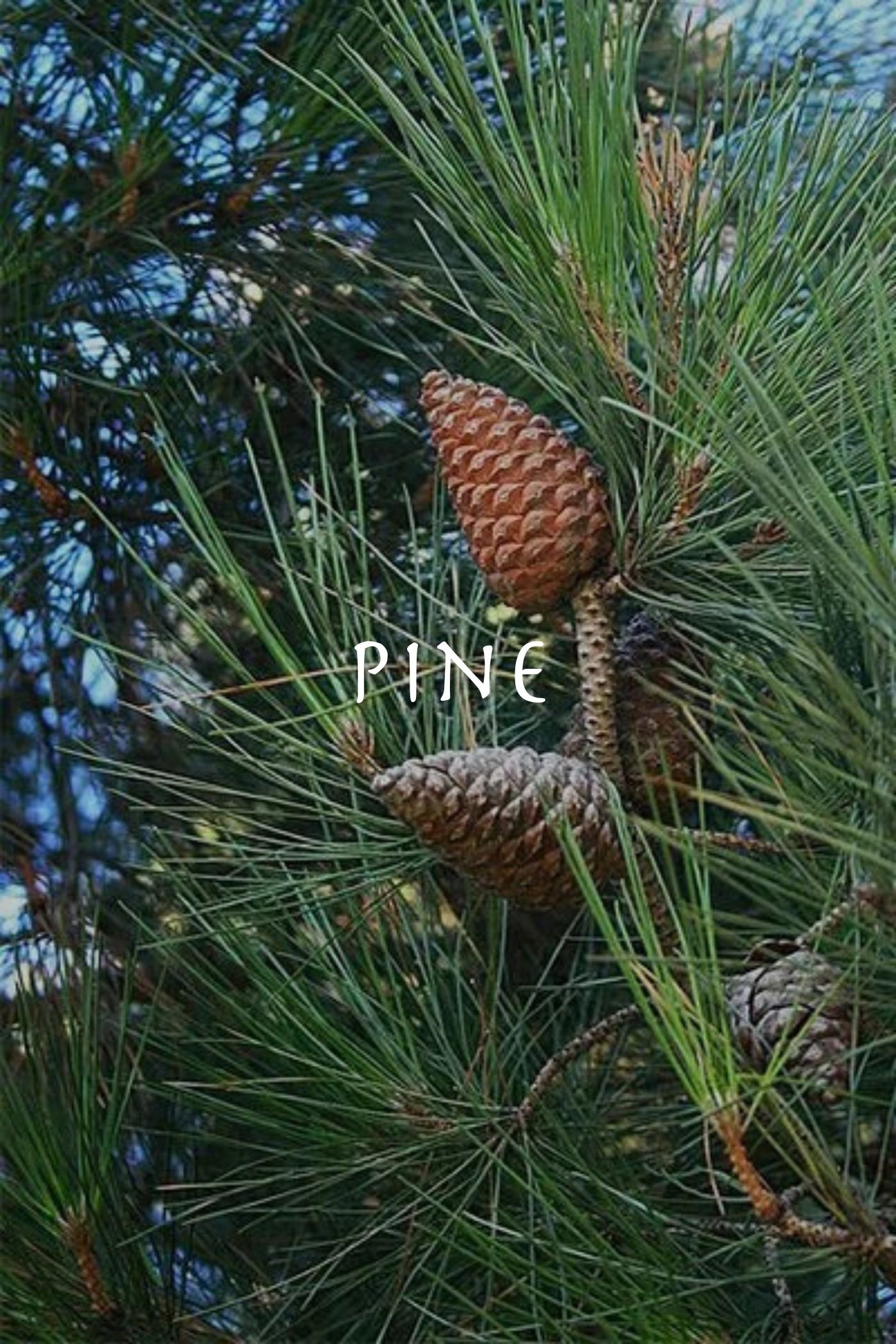
Pine

Pinus spp.
Resilience - Protection
The Pine is a resinous, coniferous evergreen found blanketing the mountainsides and dotting the coastal regions of the Mediterranean. Five main species of Pine grace the Greek landscape. Used since antiquity for everything from medicine to perfume to culinary dishes, the Pine also has a long history in ship building, linking the tree to the sea god Poseidon. Protected by the oreiades and loved by the god Pan, the Pine is also sacred to Dionysos, god of revelry and the vine. A potent teacher of strength in the face of life’s challenges, Pine can be incorporated into daily ceremonies to strengthen resilience and bring protection. Keep reading below to learn more about the Pine.
Index
The Pine in the Wild & Garden
![Pinus halapensis botanical drawing by Aylmer Bourke Lambert (1761—1842) [Public domain via Wikimedia Commons]](https://images.squarespace-cdn.com/content/v1/5e022435901d26328f573f43/1577545808519-WDLCPY81Z8JNVGH93T6U/Pinus-Halapensis-Aylmer+Bourke+Lambert+%281761%E2%80%941842%29+%5BPublic+domain%5D.jpg)
Pinus halapensis botanical drawing by Aylmer Bourke Lambert (1761—1842) [Public domain via Wikimedia Commons]
LATIN BINOMIAL
Pinus spp. The five main species in Greece are P. halepensis (Aleppo Pine), P. pinea (Umbrella or Stone Pine), P. brutia (Rock or Turkish Pine), P. nigra (Black Pine), and P. heldreichii (Heldreich’s or Bosnian Pine)
PLANT FAMILY
Pinaceae
COMMON ENGLISH NAMES
Pine
COMMON GREEK NAMES
Πεύκο
CHARACTERISTICS
Coniferous evergreen tree; resinous with needle-like leaves; found in diverse environments and climates, from hot and dry coastal regions to cold and moist mountaintops; typically live between 100 to 1000 years, some as old as 3000
NATIVE HABITAT
Varies, depending on species, but indigenous to the Northern Hemisphere

P. brutia; photo by Gerhard Haubold CC BY-SA 4.0 via Wikimedia Commons
PREFERRED CLIMATE & CONDITIONS
Varies widely, depending on the species; typically grow well in acid, sandy soils; many are adapted to extreme elevations and temperatures
P. halepensis (Aleppo Pine) and P. pinea (Umbrella or Stone Pine) are low altitude pines found in coastal regions and prefer hot and dry weather
P. brutia (Rock or Turkish Pine) is found up to 1200m above sea level in Athos, Thrace, Crete, and the eastern Aegean islands
P. nigra (Black Pine) grows to an altitude of 1800m in the Pindos region, as well as in Macedonia and the Peloponnese
P. heldreichii (Heldreich’s or Bosnian Pine) is the hardiest and can grow up to 2400m above sea level and is mostly found in the northern Pindos region and Mount Olympos
TYPICAL HEIGHT AND SPREAD
Depends on species, but reaching anywhere from 12 to 55 meters (39-180 feet) in height
P. halepensis (Aleppo Pine) is irregular in shape between 12 to 20m (39-65 ft) in height
P. pinea (Umbrella or Stone Pine) is umbrella-shaped between 15 to 25m (49-82 ft) in height
P. brutia (Rock or Turkish Pine) grows between 20 to 35m (65-115 ft) in height
P. nigra (Black Pine) is tall and pyramidal between 20 to 55m (65-180 ft) in height
P. heldreichii (Heldreich’s or Bosnian Pine) grows between 25 to 35m (82-115 ft) in height
![P. brutia; photo by Franz Xaver [CC BY-SA 3.0] via Wikimedia Commons](https://images.squarespace-cdn.com/content/v1/5e022435901d26328f573f43/1577545942320-B5553IXSIY2MBFHU86LS/Pinus_brutia_4.jpg)
P. brutia; photo by Franz Xaver [CC BY-SA 3.0] via Wikimedia Commons
BLOOM COLOR AND CHARACTER
Pines are typically monoecious, with pollen (male) and ovulate (female) cones on the same tree; cones vary in length from 6 to 18 centimeters (2-6 inches) long, depending on the species, and can be oblong or round; ovulate cones begin green and mature after pollination over a period of several years, changing to a red-brown or brown color, and slowly opening to disperse their seeds (forest fire can hasten the opening time)
COMMON DISEASES
Needle blight; Pine wilt; when a Pine tree is injured, it exudes a thick resin from the wound as an antimicrobial protective layer to catch boring insects and keep out infection
NOTES ON PROPAGATION, HARVEST, AND PRESERVATION
This can vary widely, depending on the specific species of Pine being grown. For example, P. halepensis (Aleppo Pine) prefers full sun with hot and dry conditions (Zones 8 to 10) while P. nigra (Black Pine) prefers slightly colder conditions (Zones 4 to 7).
Propagate: from cuttings or seeds
Grow: depending on the species, grows well in the garden as a single tree or as hedges; prefers full sun
Prune: prune damaged or diseased branches any time of year
Harvest: when a Pine tree is injured, it exudes a thick resin as an antimicrobial protective layer to catch boring insects and keep out infection; harvest resin any time of year (remove carefully from drippings, not from wound site); harvest needles any time of year (older needles have the highest Vitamin C content; younger needles taste a bit better); harvest bark and pollen in spring
Preserve: needles, bark, resin, and pollen can all be preserved in alcohol tincture; needles and bark can be dried or used fresh for tea (infusion and decoction, respectively); resin is often infused into an oil or salve


How to tell the difference between a Pine, Fir, Spruce, and Cypress tree?
Many people, myself included, have a hard time telling the difference between these most common Mediterranean evergreen conifers — Pine, Fir, Spruce, and Cypress. Read my short guide here.
The Pine in Greek Mythology
![Two satyrs and a maenad on a red-figure kalyx-krater, 380–370 BC, Louvre Museum [Public domain] via Wikimedia Commons](https://images.squarespace-cdn.com/content/v1/5e022435901d26328f573f43/1577546029239-LP2HF9MFSTQQW6OXGEZJ/Satyroi_Mainade_Louvre.jpg)
Two satyrs and a maenad on a red-figure kalyx-krater, 380–370 BC, Louvre Museum [Public domain] via Wikimedia Commons
![A red-figure amphora of Dionysus holding a wine cup (kantharos) and thyrsus, c. 480 BCE; Photo by Carole Raddato [CC BY-SA 2.0] via Wikimedia Commons](https://images.squarespace-cdn.com/content/v1/5e022435901d26328f573f43/1577546084606-0COTT6XS3BTH0QINRJXE/Dionysus_holding_a_wine_cup_%28kantharos%29_and_thyrsus_and_heraldic_lion_on_his_arm%2C_red-figure_Amphora%2C_by_the_Berlin_Painter%2C_c._480_BC%2C_Staatliche_Antikensammlungen%2C_Munich_%288958047568%29.jpg)
A red-figure amphora of Dionysus holding a wine cup (kantharos) and thyrsus, c. 480 BCE; Photo by Carole Raddato [CC BY-SA 2.0] via Wikimedia Commons
Dionysos
The Pine is sacred to Dionysos, who among many things, is god of revelry, wine, and viticulture. In ancient times, Pine resin was used to seal ceramic wine vessels (called amphora) and was also added intentionally to fermenting grapes for flavor and possibly for its medicinal and spiritual properties (today, this resin-flavored white wine is called retsina).
As a god of the mountain and wild places where conifers grow, Dionysos and his maenads were often depicted carrying a Giant Fennel staff called a thyrsus (which some say was topped with a Pine cone and wrapped in Ivy) and they are sometimes seen wearing wreaths of Pine.
Poseidon
The Pine was also closely linked to the sea god Poseidon as the tree’s wood was prized as a ship building material for its ability to withstand decay. Pine pitch (resin) was also used for waterproofing, as a sealant for joints, and as a flame retardant for ships at sea. And winners of the Isthmian games, a pan-Hellenic athletic festival held in Corinthos and dedicated to Poseidon, were crowned in wreaths of Pine.
It is thought that Poseidon’s sacred groves consisted of Pine trees, especially the coastal varieties such as the Aleppo (P. halepensis) or Umbrella (P. pinea) Pine.

The Corinthian mountains in the Peloponnese with evergreens in the foreground
Oreiades, Pan, and the mountain groves
The oreiades are nymphs inhabiting conifer trees; they are responsible for growing, nurturing, and guarding the Pine, Fir, and Cypress.
All conifer trees, but especially the Pine, are sacred to the god Pan, who wanders mountain groves with his panpipe.
There are also stories of the nymph Pitys, who fled from Pan’s lustful advances and was transformed into a Pine tree in order to escape the god’s desire.
Back to top
The Pine in Ceremony
Resilience - Protection
Pine is a potent teacher of resilience in the face of life’s challenges and changes.
Each species of Pine is adapted to weather the extremes of their environment. Mountain Pines are pyramidical in shape, able to withstand a heavy burden of freezing snow, while irregularly-shaped coastal Pines are adapted to withstand blistering summer droughts and sea-laden winds. All Pines, when wounded, exude a sticky resin that acts as an antimicrobial protective layer to catch boring insects and keep out infection. It takes years for Pine’s pollinated cones to ripen and shed their seeds for a new generation. And even in the depths of winter, when other plants are either dormant or dead, the Pines are still green, swaying and flexible even in the harshest winds.
These trees are evergreen in every sense of the word: strong, patient, and enduring. Closely connected to the wild gods of the sea and mountains, Pine is a powerful ally to stay grounded in the wake of uncertainty and chaos. Pine’s flexibility in the face of extreme weather and Pine’s self-protective sap are both a reminder to call upon our own innate resilience and self-healing capabilities. When life’s challenges seem unendurable, we can call upon Pine’s sturdy strength to protect and strengthen our heart.
![P. brutia; photo by Franz Xaver [CC BY-SA 3.0] via Wikimedia Commons](https://images.squarespace-cdn.com/content/v1/5e022435901d26328f573f43/1577546218135-E9NXY7EQJAXX05OG9NQI/Pinus_brutia_5.jpg)
P. brutia; photo by Franz Xaver [CC BY-SA 3.0] via Wikimedia Commons
Parts Used
resin, needles, branches, cones
Safety
considered generally safe to consume and burn
Elemental Correspondence
Seasonal Celebrations
Metal Season through Cosmos Season
Altar
Pine branches can be added to the altar for protection and used as brooms for sweeping and clearing spaces. Collected Pine cones and needles can be sprinkled on the altar or burned as protective smoke to guard the altar space and home. The resin can similarly be burned on charcoal blocks, chewed before ceremony, or infused into anointing oils for protection and strength.
Ceremony
Include the Pine in ceremonies for protection or anytime extra resilience is needed. Wear wreaths made from Pine branches or brush your body with the soft needles, visualizing a protective barrier coating your skin and body. Create a sacred anointing oil from the resin or pine-infused olive oil, and dab the oil on your wrists and breastbone whenever you need support for enduring difficult times. Burn collected needles or wood in a sacred, protective fire to warm the home and imbue your space with resilient energy. Drink or share an offering of retsina, the Greek wine made with Pine resin, to honor the strong and steady Pine.
In Winter, decorate the living or cut tree with strings of lights as an evergreen reminder of the resilient nature of the Pine and the cyclical promise of the Sunlight’s return at the Winter Solstice.
Given Pine’s use as a resilient wood and protective sealant in ancient ship building, the wood can also be worn as a protective amulet during sea travel, especially for those weary of ships.
Devotion
Whether before your altar or the living tree, hold a branch of the Pine in your hands and read the following devotion:
Pine, protector of mountaintops,
Guardian of coastal edges,
teach me flexibility, resilience and strength
in the face of life’s many storms.
Back to top
The Pine in the Kitchen & Apothecary
![Two glasses of retsina; photo by Yorick R. [CC BY-SA 2.0] via Wikimedia Commons](https://images.squarespace-cdn.com/content/v1/5e022435901d26328f573f43/1577546425035-HGSNBID17CSIZV9543ZW/image.jpg)
Two glasses of retsina; photo by Yorick R. [CC BY-SA 2.0] via Wikimedia Commons
Parts Used
needles, resin, bark, seeds, pollen
Culinary Flavor and Use
Pine needles have a sour or pungent flavor and can be eaten raw for their high Vitamin C content or infused into honey or water as a daily tea, especially during the winter months.
Pine nuts can be added to salads and warm dishes, alike. The P. Pinea (Stone or Umbrella Pine) was particularly prized in antiquity for its edible seeds.
Pine pollen is considered a nutrient-dense food and can be harvested from the male cones in spring and added to meals. Honey made from pine pollen is also available from some Greek beekeepers. It is also possible to make a Pine-infused honey by gently warming and infusing Pine needles into any kind of honey.
When a Pine tree is injured, it exudes a thick resin as an antimicrobial protective layer to catch boring insects and keep out infection. This resin can be harvested and eaten raw or made into various medicinal preparations. Traditionally, it was used as a depilatory and additive for perfume. The resin is still used today in the making of retsina (ρετσίνα), a Greek white or rosé wine, in which the grapes are fermented with the resin.
Traditional Medicinal Applications
The Pine is warming and drying, especially suited to treating cold and flu symptoms (congested lungs, sore throat, and thick mucus), healing various skin conditions, and easing muscular pain.
An infusion from the needles can be drunk as a stimulating diaphoretic, expectorant, and diuretic. The resin can be infused in oil or salve and used as a chest or muscle rub and applied as a vulnerary and antimicrobial for wounds and skin ailments. The resin and needles can also be eaten raw or gently infused into honey.
Safety and Drug Interactions
Generally considered safe to consume.