Ivy

Hedera helix
Ecstasy - Perenniality - Freedom - Altered Consciousness
The Ivy is a hardy, evergreen, perennial vine with dark green leaves, greenish-yellow flowers in autumn, and purple-black berries in winter. Sacred to the god Dionysos, the Ivy features in nearly all iconography of the god and his retinue. Worn as crowns, wrapped around the thyrsus, and possibly even consumed by the Maenads in celebration of the Dionysiac Mysteries, the Ivy teaches ecstatic release and abandon. In the hands of the Maenads, the Ivy encourages the abandonment of social convention, the leaving behind of “sane” behavior, and the expansion of what we would consider reality. Traditionally used to treat ailments such as skin infections, respiratory issues, parasites, and jaundice, the Ivy vine was also said to cause sterility and used as a contraceptive in ancient times. Keep reading below to learn more about the Ivy.
Index
The Ivy in the Wild & Garden
LATIN BINOMIAL
Hedera helix
PLANT FAMILY
Araliaceae
COMMON ENGLISH NAMES
Ivy, Common Ivy, English Ivy
COMMON GREEK NAMES
Κισσός
CHARACTERISTICS
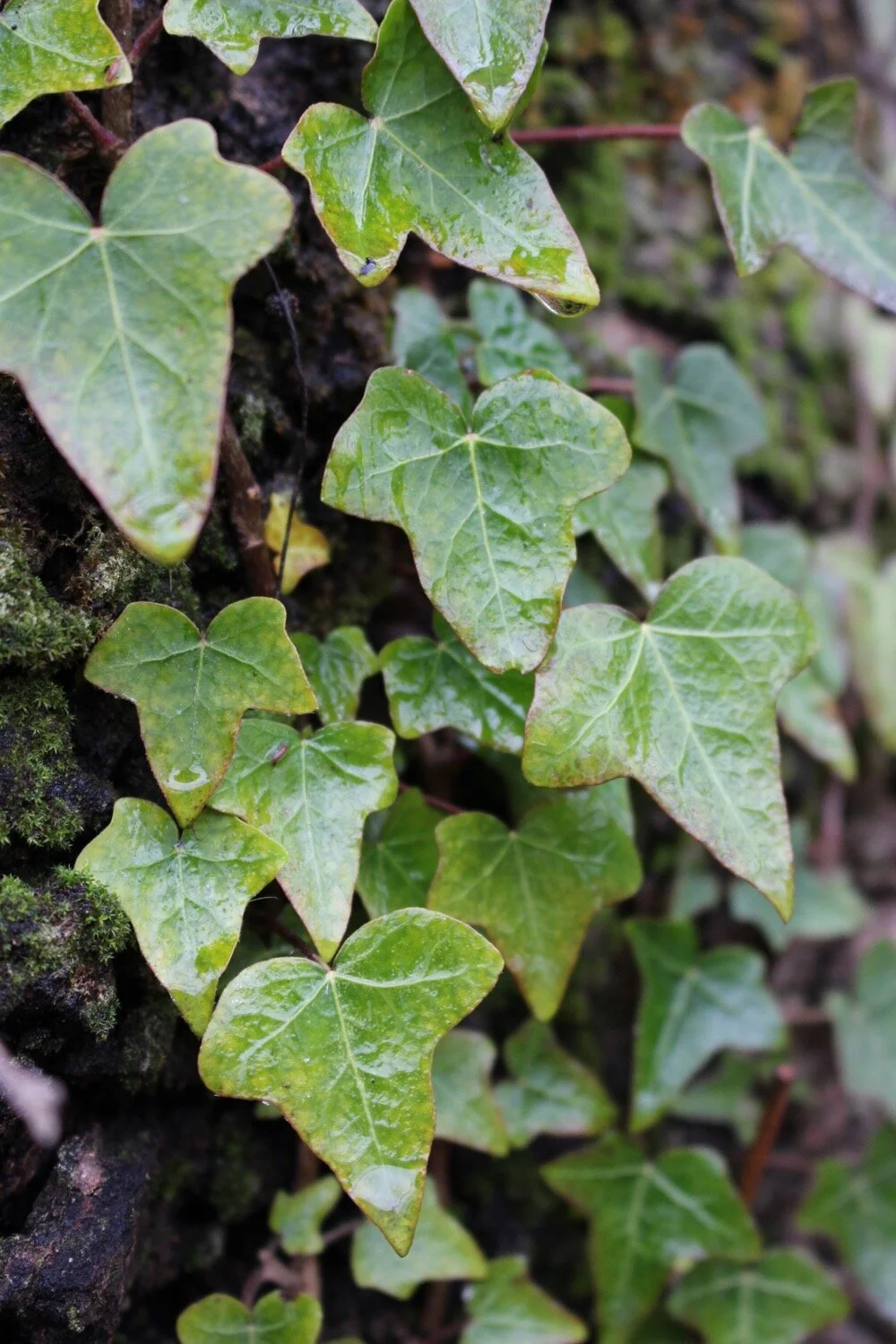
Hardy, climbing evergreen perennial vine with dark green, glossy leaves. Mature vines become woody and often form large shrubs when they’ve reached the top of their climbing support. Ivy provides shelter for roosting and nesting birds, as well as insects.
NATIVE HABITAT
Europe, North Africa, and western Asia
PREFERRED CLIMATE & CONDITIONS
Prefers deciduous forests where it can climb trees, rocks, or cliffsides in partial to full shade. Relatively drought tolerant and hardy to US Zones 4-9.

TYPICAL HEIGHT AND SPREAD
Vines can reach 20-25 meters (65-80 feet) or more in length
BLOOM COLOR AND CHARACTER
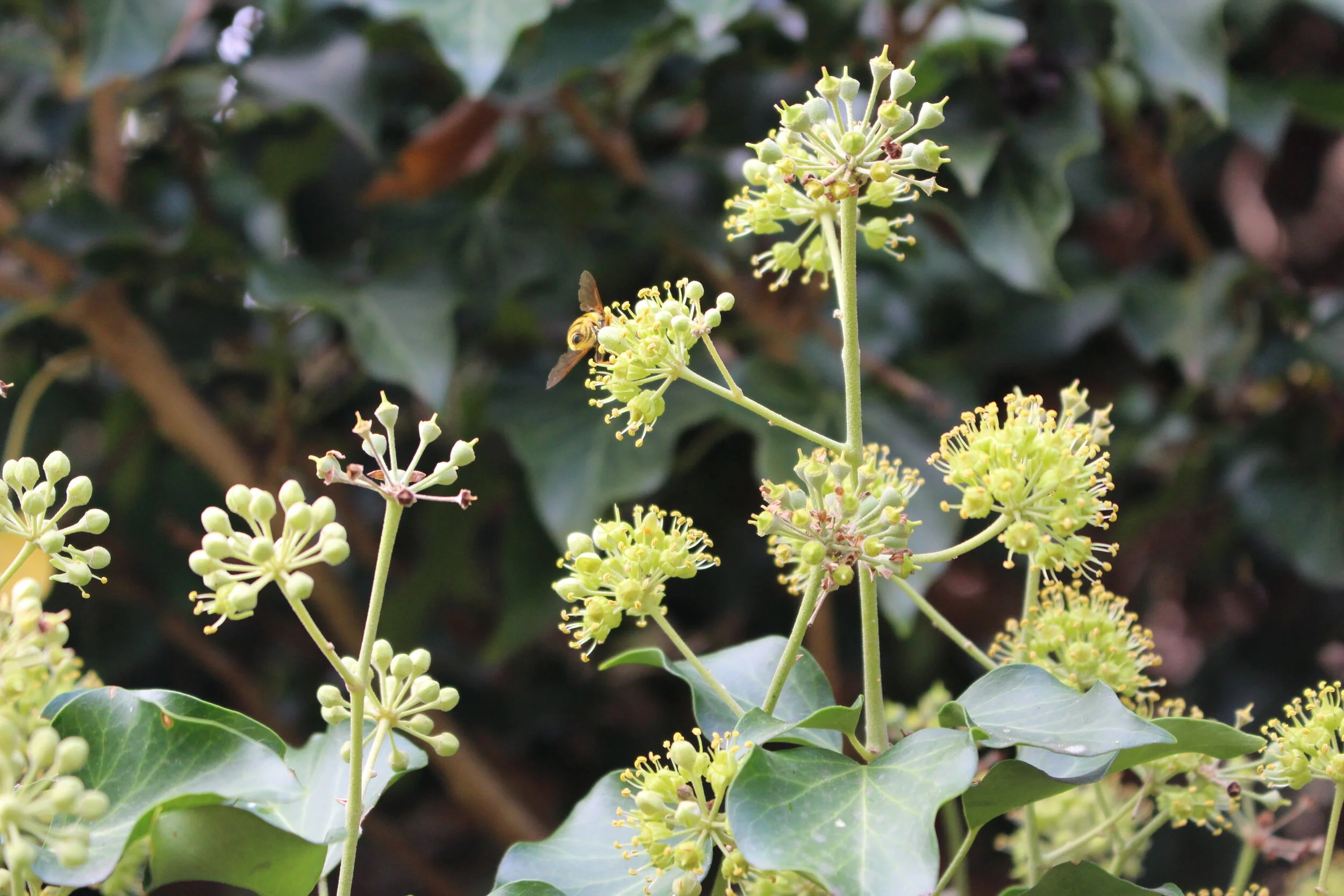
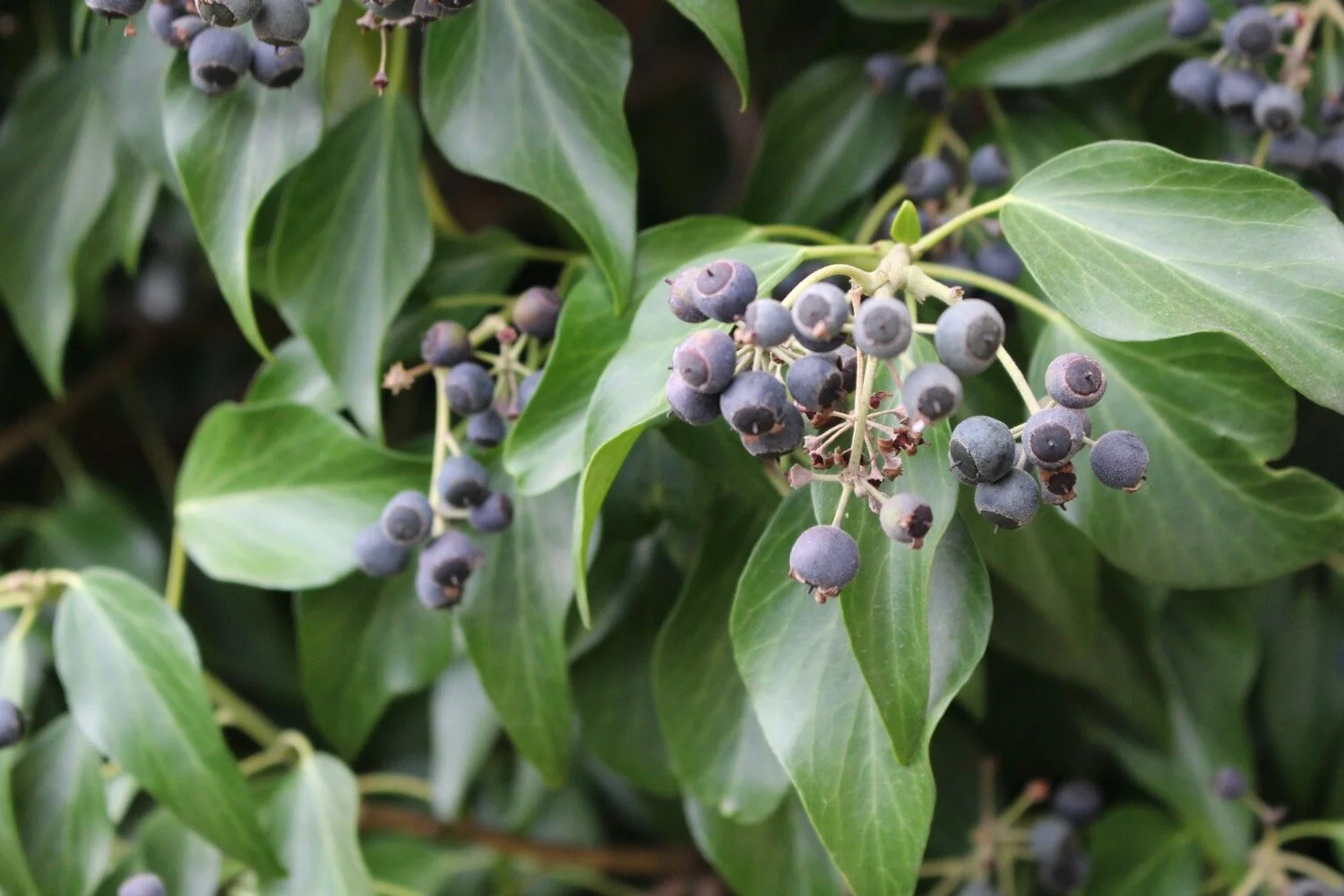
Greenish-yellow flowers form spherical umbels in October and November and provide a vital source of late autumn pollen and nectar for pollinators such as bees, wasps, and flies. (As it is one of the last flowering plants before winter, an Irish naturalist once told me that he suspects the flowers have a mild sedative effect on the honeybees as they prepare to hibernate for winter. I’ve not been able to verify this in my research, but it stuck with me nevertheless as a naturalist’s observation.) Purple-black berries ripen and provide winter food for birds, who disperse the seeds.
Care In the Garden
Ivy grows quickly and vigorously, and is often considered invasive in non-native regions. Propagate via cuttings and grow as a ground cover (especially to help with erosion) or as a climbing vine. Support ivy on trellises, stakes, or walls, but beware: it easily takes over, climbing nearby hedges, trees, buildings, and structures. Pruning is encouraged to control its spread and prevent unwanted structural damage to buildings and walls. Can be grown indoors, particularly in hanging baskets.
SAFETY CONSIDERATIONS
Many sources will list Ivy as toxic to humans and animals, however, this is not fully accurate. Like many other herbs, Ivy can cause nausea and vomiting when taken in large doses. The leaves can also cause contact dermatitis in some people. Ivy has been traditionally used as medicine when administered with the correct preparation and dosage. Handle with caution.


The Ivy in Greek Mythology

A red-figure amphora ca. 500 BCE depicting Dionysos crowned in an ivy wreath, holding a grapevine, and flanked by an ivy-crowned satyr and an ivy-crowned maenad (who holds an ivy-topped thyrsus and a serpent). The handles of the amphora are decorated with ivy leaves. © The Trustees of the British Museum, CC BY-NC-SA 4.0, via britishmuseum.org.
Dionysos and the Ivy Vine
The Ivy — like all vines — is sacred to Dionysos, who among many things is god of revelry, theater, and sacred madness. As a twice-born god associated with the perennial, evergreen, burgeoning Ivy, he is often celebrated as an embodiment of immortality, wildness, and fertility. The Mysteries of Dionysos included altered states of consciousness via intoxication, frenzied devotion, and ecstatic dance, and the god is often depicted wearing wreaths of Ivy and surrounded by a retinue of Ivy-crowned, dancing Satyrs and Maenads (see below). Dionysos is also credited with bringing wine cultivation to the Greeks and visual representations of the god often include Grapevines. His other symbols include masks, mirrors, eyes, phalloi, pillars, collumns, and trees (such as the Pine, Poplar, and Fig), as well as bulls, snakes, and wild cats — such as lions, leapords, and panthers.
The Maenads

A red-figure cup ca. 480 BCE depicting a maenad crowned in an ivy wreath, holding the thyrus (ivy-topped giant fennel stalk), draped in animal skin, and holding a deer. in the Louvre Museum via Wikimedia Commons
The Maenads (μαϊνάδες) were followers of Dionysos and are depicted with the god in scenes of dancing, drinking, music-making, and ecstasy. Their name literally means “raving ones” and they enter divine trance states via sacred intoxication and movement. They are most often depicted bearing a thyrsus (a Giant Fennel stalk wrapped in Ivy), wearing deer or wildcat skins, crowned with Ivy wreaths or bull helms, and handling or donning serpents. They are usually dancing or depicted with heads thrown back and their bodies in ecstatic states, sometimes holding krotala (a type of castanet or rattle that produces a trance-inducing sound).
Unlike the other nymphs, the Maenads are said to be humans who are wholly transformed by their frenzied devotion, leaving behind social norms to become primal and free. An important aspect of the Maenads is sparagmos — their superhuman ability to tear apart wild animals or even other humans — and omophagia — their consuming of raw, bloody meat. Various scholars have theorized what these abilities mean (either as a representation of the crushing and rending of Grapes, the juice running red like blood, or as a connection to the “dying and reviving” god principle as embodied in Dionysos, Orpheus, and Osiris), and whether these descriptions of maenadic behaviour should be taken literally or symbolically.
(For more guidance in connecting with the Maenads, I invite you to explore this guide.)

A red-figured kylix ca. 520BCE depicting dancing maenads holding the thyrsus (Ivy-topped Giant Fennel) and krotala (castanets) with ithyphallic satyrs. This is the rim of the cup whose interior features a woman holding two phalloi (see below). © The Trustees of the British Museum, CC BY-NC-SA 4.0, via britishmuseum.org.
Ivy, sexuality, and the Dionysiac Mysteries
Some scholars, namely Carl A.P. Ruck, argue that the Maenads used the hollow Giant Fennel thyrsus as a vessel for collecting and/or mixing entheogenic herbs and mushrooms. These herbal concoctions would have been either ingested (for example, in an infused wine) or applied internally as an anal or vaginal suppository (probably with a phallus-shaped applicator). It’s unclear exactly how the Ivy would have been a part of this, but much like a witches’ flying ointment of the Medieval period, it’s possible the Ivy would have been included in a recipe for ecstatic union with the divine.

A red-figured kylix ca. 520BCE depicting a naked woman holding two phalloi. The Phallus pointing toward her mouth seems to have an eye on its head. This is the inside of the drinking cup whose rim is featured above. © The Trustees of the British Museum, CC BY-NC-SA 4.0, via britishmuseum.org.
In the De Materia Medica (2-210), Dioscorides lists several medicinal uses of the Ivy, among which include applying a leaf-and-honey vaginal suppository to induce menstruation, and tells us that “the juice and clusters [of fruit] (taken as a drink) cause sterility, and taken in too great an amount trouble the mind.” Given Ivy’s traditional use as a contraceptive, it does not surprise me to see it in Dionysos’s retinue, especially when wrapped around the Giant Fennel, which was also said to have contraceptive and abortifacient properties. Is it possible the Maenads — who embodied (albeit temporary) freedom from social norms, particularly the traditional roles of womanhood and motherhood — were using Ivy as a form of birth control (either alone or combined with other plants, such as Giant Fennel and other Ferula spp.)? How might the thyrsus, in particular, represent sexual freedom and female agency?
During a short period of vase iconography, the thyrsus is sometimes pointed by a Maenad directly at the erection of a satyr. Some scholars interpret this as an act of violence, that the Maenad is deterring the satyr’s sexual advances with aggression. I personally wonder if the iconography has more to do with symbolically rendering the satyr’s semen ineffective, rather than enacting violence against him (especially since earlier images depict Maenads and Satyrs dancing or sexually engaging together harmoniously).
I also think it’s interesting that in myths when the Dionysiac Mysteries were rejected and the god’s divinity was questioned (such as with King Lycurgos, King Minyas’s daughters, King Pentheus, Perseus, and more), Dionysos drove the women (and sometimes men) of their families or cities insane. Their madness almost always resulted in their murdering or devouring their own children or — in the myth of Ikarios and Erigone — driving all young Athenian maidens to commit suicide. What did the ecstatic experience of divine union do for and to the women who practiced the Dionysiac mysteries? What kind of healing or deeper wisdom did they embody after such rites? And how was that experience so important to ancient social cohesion that the myths repeatedly warn ancient leaders not to deny women access to those sacred rites, lest they go mad?
To be clear, I’ve not seen this theory that the Ivy and Giant Fennel’s combined contraceptive properties were the reason for their use by the Maenads, but based on what I’ve been reading about ancient contraceptives — combined with the iconography and myths of the Maenads — I think it’s an interesting theory to explore. (See the Library, particularly the “Selected Academic Articles & Websites” section, for resources on ancient Greek contraceptives, as well as on the iconographic representations of the Maenads and Satyrs.)
Ambelos, the HAMADRYAD
According to Atheneaus, Ambelos (‘Αμπελος) was the Hamadryad nymph of wild vines, including the Ivy. The Hamadryades were eight (or more) tree nymphs, children of Oxylos (whose name is connected to the Greek word for Beech tree) and Hamadryas (whose name means “one with tree”).
It may seem strange to include a climbing vine in a list of Dryad tree nymphs, but wild vines are an integral part of the forest as they climb trees to reach the sun. In ancient times, Grapevines were also often cultivated on living trees such as the Elm, Poplar, or Ash.
Back to top
The Ivy in Ceremony
Ecstasy - Perenniality - Freedom - Altered Consciousness

Sacred to the god Dionysos and his retinue of Maenads, the Ivy is a vine of ecstatic release and abandon. Worn as crowns, wrapped around the sacred thyrsus, and possibly even ingested by the ancients in ecstatic rituals for divine union, the Ivy is a teacher of freedom.
As an evergreen perennial that grows with vigor, the Ivy swallows all that it encounters: climbing and twining around trees like a lover, covering structures, and consuming ruins in a display of nature’s perenniality in the face of human mortality and decay. I’ve intentionally used the word “perenniality” instead of “immortality” to emphasize the cyclical, eternal nature of the Ivy. In English, the word immortality carries for me connotations of ascension culture, and while it’s true that Ivy (like most vines) climbs up, it cannot do so without first being rooted in the ground. In this way, the Ivy (its scientific name being Hedera helix) spirals up and down the cosmic tree.
The Ivy also encourages the abandonment of social convention, the leaving behind of “sane” behavior, and the expansion of what we would consider reality. Given its connection to the Mysteries of Dionysos — whose symbols also included the mask, the mirror, and eyes — the Ivy has the potential to change the way we perceive reality, breaking us from the confines of socially acceptable behavior to experience true freedom. Especially when combined with the Grapevine, whose essence is one of dissolving boundaries and joyful communion, the Ivy encourages us to access altered states of consciousness to understand the true nature of the cosmos.
Just as the Maenads are said to tear apart and consume wild animals (sparagmos and omophagia), so does the Ivy’s wisdom tear apart our sense of reality, the very fabric of our perceived and known universe. These mysteries are not for the faint of heart, as they can bring you to the very edge of who and what you think you are.
Parts Used
vines, leaves, berries
Safety
Many sources will list Ivy as “toxic” to humans and animals, however, this is not fully accurate. Like many other herbs, Ivy will cause nausea and vomiting when taken in large doses. The leaves can also cause contact dermatitis in some people. Ivy has been traditionally used as medicine when administered with the correct preparation and dosage. Handle with caution.
Elemental Correspondence
Seasonal Celebrations
CEREMONY
Ivy can be invited to ceremonies when seeking freedom from social norms, conventions, and definitions of “reality,” especially where gender roles, sexuality, and human identity are concerned.
Ivy is also a particularly powerful ally for entering altered states of consciousness, whether through meditation, sex, dance, music, sacred theater, or the imbibing of entheogenic substances (which is best navigated with a guide, someone trained in the art of sacred intoxication).
Draw representations of Ivy on tools used for altered states of being, such as masks, mirrors, and trance-inducing instruments. Crowns of Ivy can be worn over the third eye, draped as garlands, or wrapped around a pillar or trunk to represent the twining of the cosmic tree. (If you intend to handle or wear Ivy, please be sure to do a small patch test on your skin first to be sure you are not allergic).
Especially when combined with Grape in ritual, the two vines together encourage a joyful communion with the divine. Together, they honor the unifying principle that dissolves all boundaries of the self, tears apart our limited sense of reality, and merges us with the divine mysteries of the universe. Weave Grape and Ivy together in a double-helix crown or garland. Craft Ivy-infused wine, Grape juice, or vinegars to combine these two powerful vines and offer them to the earth in sacred awe for the perenniality of the cosmos.
You may also want to consider inviting Rough Bindweed into your ceremony as a means of reestablishing boundaries upon reentry from altered states.
Many of the same practices I suggest in this guide to communing with the Maenads can also be applied to connecting with the spirit of Ivy.
Devotion
Whether before your altar or the living vine, read the following:
Evergreen Ivy,
spiraling the cosmic tree,
render me, consume me,
that I may experience
the ecstasy
of true
freedom.
The Ivy in the Kitchen & Apothecary

Parts Used
leaves, berries
Culinary Flavor and Use
Ivy is not typically used in the kitchen, however, Ivy honey can be. It is thick and crystalline, and it is one of the last honeys produced by bees before hibernation. Be sure to acquire it from reputable sources who know how to care for their bees, as Ivy honey can be vital for helping bees get through the winter.
Traditional Medicinal Applications
Traditionally, Ivy has been used for a long list of ailments, including skin infections and ulcers, rheumatism, respiratory issues, parasites, and jaundice. The leaves were boiled in water, wine, or vinegar and then either drunk or used as an external wash, or the berries were powdered and ingested. According to Dioscorides’ De Materia Medica, “the juice and clusters [of fruit] (taken as a drink) cause sterility, and taken in too great an amount trouble the mind.” Various preparations of the plant (either berries or leaves) were used as a menstrual stimulant, contraceptive, or abortifacient (p351-2). Ivy honey (mentioned above) is traditionally used for treating congestion and respiratory ailments.
Safety CONSIDERATIONS
Many sources will list Ivy as “toxic” to humans and animals, however, this is not fully accurate. Like many other herbs, Ivy will cause nausea and vomiting when taken in large doses. The leaves can also cause contact dermatitis in some people. Ivy has been traditionally used as medicine when administered with the correct preparation and dosage. Handle with caution.


