Invoking the Muse
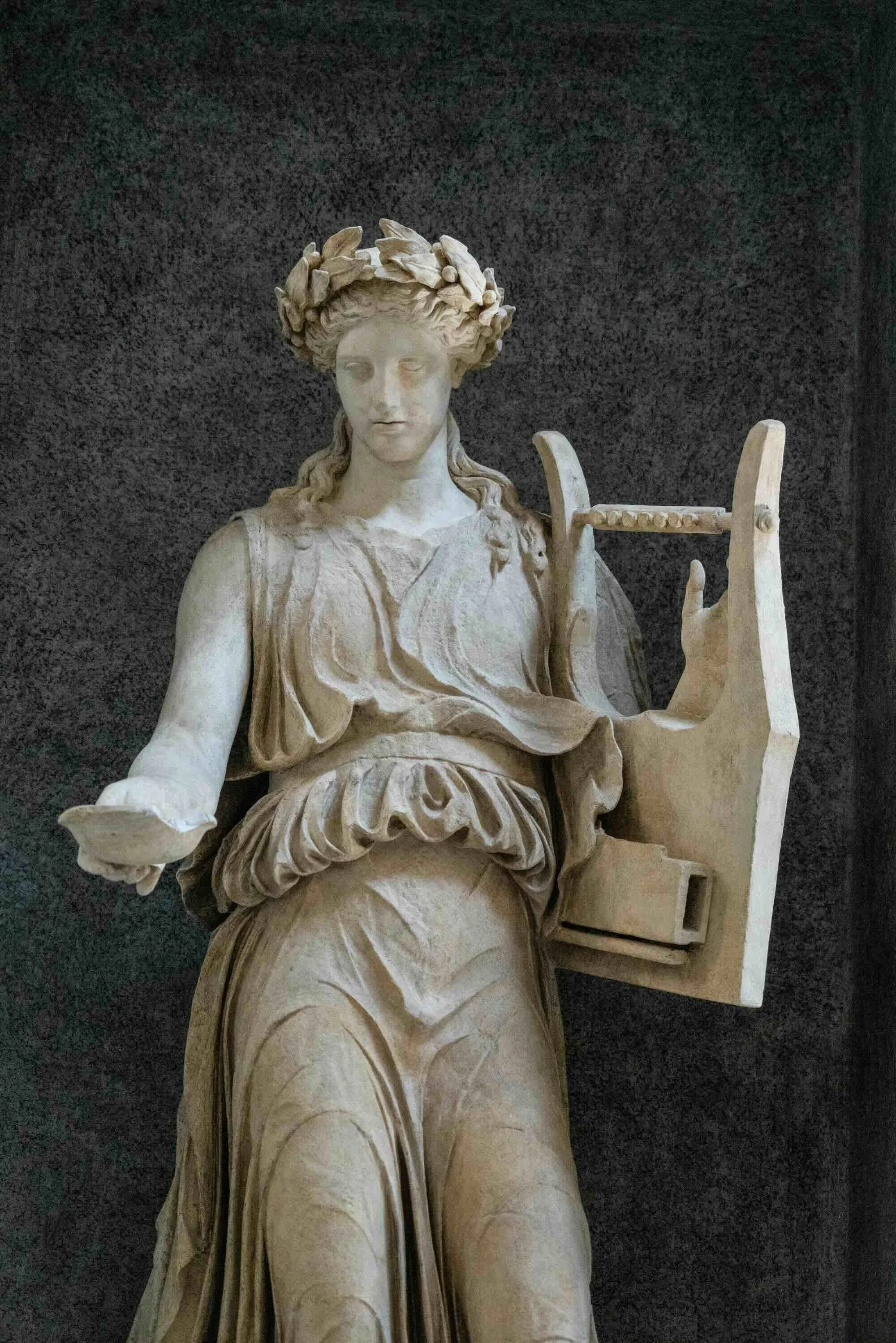
Were there really nine muses in ancient Greece? Where were they worshiped? And what do their stories tell us about artistic inspiration and the Greek landscape? In this episode, meet the ancient Greek Muses and learn more about their special relationship with music, winged messengers, springs, and the Greek gods of prophecy and sleep.
Listen below or with your favorite podcast provider
APPLE | SPOTIFY | Youtube | Amazon | DEEZER | PANDORA
Scroll down for show notes and the transcript.
Mentioned in this Episode
Birds of Greece
YouTube Playlist of Greek Bird Calls, Facts, and Bird Watching
Related Episodes
Hypnos and the Poppy: Ancient Greek Dream Incubation
The Melissae, Oracular Bee Nymphs
QUOTES and Sources
Hesiod, Theogony: https://topostext.org/work/4
Homer, Iliad: https://topostext.org/work/2
Homer, The Odyssey: https://topostext.org/work/3
Pausanias, Description of Greece: https://topostext.org/work/213
Liberalis, Antoninus, The Metamorphoses of Antoninus Liberalis: https://topostext.org/work/216
Ovid, Metamorphoses: https://topostext.org/work/141
Theoi.com: The Mousai, The Mousai Apollonides, Mousai Titanides
Olalla, Pedro. Mythological Atlas of Greece.
Find more resources in my Library
MAP of the Muses
Related Articles




Transcript
You're listening to A Temple Wild, episode 17, Invoking the Muse
Hello and welcome to A Temple Wild, where we rediscover the myths of the ancient Greeks through the plants and landscapes that shaped them.
My name is Mira and in today’s episode, we’ll be meeting the ancient Greek Muses: who they were, where they were, how many of them were there, and what role they played in ancestral storytelling and artistic inspiration.
Now as an artist, this episode was really interesting to research because, like most people, I’d grown up thinking that there were nine Muses: each goddess with her own artistic domain — from various types of poetry and theater, to even history and astronomy.
But, as we’ll see in this episode, some of the earliest accounts of the Muses mention only three of them, and while today they are invoked by artists of all mediums — whether you’re sculptor, a painter, a novelist, or an actor — their first relationship was with music, with dance, and with divine revelation.
They were linked to the god Apollo, to winged messengers like the oracular honeybee and birds, and they were also worshiped at particular mountains and springs, which of course we’ll learn about in this episode.
But before we get to all of that, I want to take a moment and thank all of you so much for tuning in to this third season of the show! I am so grateful for all your emails and private messages asking where I’ve been and inquiring about new episodes. So I am finally set up and settled in to my new apartment. It’s been a whirlwind of a year, and as some of you know, I recently just moved from Mount Paggaio, which is a mountain close to the city of Kavala in northern Greece, to the brand new city, at least brand new for me, of Ioannina. It’s been a really big change going from a tiny, tiny village to a much larger city in a brand new region of the country.
And for those of you who’ve never even heard of Ioannina (Ιωάννινα) — or Ioannina — as the locals call it - it’s a city in the northwest region of Greece. It is a mountain city, surrounded by the Pindos (Πίνδος) Mountains and right along the side of Lake Pamvotida (Παμβώτιδα), I’m not really sure how to pronounce it in English it’s Pamvotida or Pamvotis, but of course that’s not really how the Greeks say it. So, I’m still new here, obviously, but this is one of the rainiest regions of the country, which means it is much greener, it has four distinct seasons, and it is much colder in the winter than other parts of Greece. There’s a university here, there’s a growing art and food scene, and some of the friendliest people I’ve met so far living in this country. It’s also a gateway to some of the wildest and most beautiful parts of Greece, and since not many tourists have heard of it, usually the city attracts nature lovers and foreigners that have a love for the mountains, rather than the sea.
So I’ve been here only a few months, and I can honestly say though that moving here has been one of the best decisions that I have ever made. My apartment is in the center of the city, but it overlooks a Pine and Cypress forest, so I am literally three minutes from walking on forest trails, while also being able to walk, basically, everywhere in the city, including delicious restaurants and of course the lake and the castle (because yes, there is a castle here). And also, I have a social life again! Which is amazing, and after many years of feeling isolated and, quite frankly, lonely, I am really, really excited for this brand new chapter.
Yeah, so even though the noise of the city is a big change from the silence of village life, and you may hear the occasional scooter in the background, I’m really hoping that my experiences here in this new region of Greece will bring a new vibrancy to the podcast, and also to my creative work!
So thank you again for sticking it out and being patient these last couple of months with my silence, but I am back.
So, speaking of creative work, and inspiration, I think it’s time to turn our attention to the Muses. And I want to begin with a short invocation, which is attributed to Hesiod from the 8th century BCE, who says:
“Come thou, let us begin with the Muses who gladden the great spirit of their father Zeus in Olympus with their songs, telling of things that are and that shall be and that were aforetime with consenting voice. Unwearying flows the sweet sound from their lips, and the house of their father Zeus the loud-thunderer is glad at the lily-like voice of the goddesses as it spread abroad, and the peaks of snowy Olympus resound, and the homes of the immortals.”
The Muses of ancient Greece were primarily goddesses of music and dance. They gifted ancient bards with the stories and melodies that shaped their lyric poetry, animated their instruments, and inspired sacred movement.
Now the word “Muse” in Greek is Μούσα, and it’s connected to the Greek word for music, μουσική, which is also the root of our word for music.
And to say music was central to the everyday life of the ancients would be an understatement. Music accompanied most, if not all, rites of passage, communal events, and private life in Greece: including processions, religious festivals, athletic ceremonies, the symposium, theater, funerals, sacrifice and libations, household chores, weddings, military events, and more.
Greek music usually included the combination of recited poetry (lyrics) and dance, but it was not just for entertainment; it was a sacred vehicle for divine knowledge and remembered history, especially for a culture which relied primarily on oral storytelling.
So for this reason, the Muses were agents of ancestral knowledge, wisdom, and even prophecy, bestowing divine wisdom and the gift of song so that the ancient bards may know and then sing the truth of everything that has happened and everything that will one day transpire.
As Homer says in the Iliad, “Tell me now, ye Muses that have dwellings on Olympus—for ye are goddesses and are at hand and know all things, whereas we hear but a rumour and know not anything” (Iliad 2:480ff).
We’re told by some that the Muses were daughters of Zeus and Mnemosyne, Mnemosyne being the goddess of memory and the creator of language. You might remember her from the episode on Hypnos and the Poppy, in which we learned about her important role in prophecy and dreaming. And as I pointed out in that episode, for a culture that relies on the passing down of stories through lyric poetry, we can understand why the Muses would have a mother who governs memory and language.
Others say the Muses were the daughters of Apollo, the god of music and prophecy himself, whose sacred tree was the oracular Bay Laurel. Hesiod even says that the Muses themselves (and I quote) “plucked and gave [him] a rod, a shoot of sturdy laurel, a marvelous thing, and breathed into [him] a divine voice to celebrate things that shall be and things there were aforetime” (Theogony 29ff).
Early depictions of the Muses show them with musical instruments, like the lyre or the aulos, or in later depictions, holding other implements of the arts, like theatrical masks or scrolls. They’re connected to stories about birds, as well as to honeybees, both creatures — birds and honeybees — being divine messengers associated with omens and the delivery of sacred knowledge. As we learned in the episode on the Melissae: Oracular Bee Nymphs, the Bees were sometimes called Birds of the Muses, as they were said to bestow honey on the lips of gifted philosophers, poets, and singers.
And so those that were blessed by the Muses were not just adept at their artistic craft, they also possessed the ability to provoke a particular response in their audience. Ultimately, they were performers — charismatic, as well as skilled — acting as a channel or a conduit for the divine truth to flow through them and out into the world.
And so musical storytelling in general was considered a gift of the Muses, but they were also known to punish those who presumed to outperform them in song and poetry.
There is a story of Thamyris (Θάμυρις), who was not only blinded and robbed of his musical talent, but also, according to Homer, was made to forget — which I would imagine for an oral storyteller to have your memory taken away would be even more devastating than any kind of physical punishment (Iliad 595ff).
In another story recounted by Ovid, the nine prideful daughters of Pierus (Πίερος) challenged the Muses to a singing contest and lost. Being sore losers, the daughters preceded to taunt the goddesses, and so the Muses, somewhat reluctantly, transformed the daughters into birds so they could continue their complaining cacophony forever. Which species of birds they were transformed into is a bit up for debate. Some sources translate the word as Eurasian Magpies (or the Pica pica), while others say it was the Eurasian Jay (Garrulus glandarius) (Metamorphosis 5:294ff).
If you’d like to hear the song of both birds, I’ve linked to some recordings of their sounds in the show notes on my website; so perhaps you can judge which produces a greater clamor.
But in a later version of the story, it’s said that the nine daughters were transformed into nine different birds: the grebe, wryneck, ortolan, jay, greenfinch, goldfinch, duck, woodpecker, and pigeon (Antoninus Liberalis 9).
Now I don’t know very much about Greek birds, but doing research for this episode led me down a very, very deep internet rabbit hole as I started listening to the calls of each of these birds. And some of them are actually quite lovely, and very familiar, as I’ve been listening to them sing for the past nine years without ever really knowing what they were called!
So similar to the Magpie and the Jay, if you’d like to listen to each of the birds, I’ve put together a YouTube playlist with their calls, which I’ll link to in the show notes. I’ve also added to the playlist a few videos that feature some really fascinating facts about other birds in Greece, like, did you know that we actually have flamingos here? Oh yes, my friends. Flamingos. In Greece.
Now I’ve known this for a couple years because I first saw them when I visited the wetlands over near Porto Lagos (Πόρτο Λάγος), which is halfway between the cities of Xanthi and Komitini in the north, the northern region of Greece. But apparently flamingos can be found all over the country, from Chalkidiki to Corfu to Kos to even the Peloponnese, depending on the time of year. I love flamingos, so I just wanted to try to take that opportunity to stick that knowledge in this episode, so anyway if you’re interested in birds in any way shape or form, or maybe just have a little bit of a curiosity about them, definitely check out that playlist that I’ve put together on my website.
But not to digress too far, in yet another story about the Muses punishing others for their hubris, we learn of a connection between the Muses and the Sirens. And the Sirens were monsters with the bodies of birds and the heads of women whose enchanting voices would draw sailors toward their perch along rocky shorelines, where the sailors would either crash their ships and die, or waste away, forgetting to eat or drink. And as the story goes, the Sirens, even though their voices are bewitchingly beautiful, lost in a singing contest with the Muses, and so the goddesses plucked the Sirens and made crowns of their feathers (Pausanius 9.34.3).
And so while the Muses were known to gift ancient bards with the ability to recount ancestral narratives with beautiful voices, they would also punish those performers who became prideful or insolent.
There are several places sacred to the Muses in ancient Greece, but the most significant was in the region of Boeotia (Βοιωτία) in central Greece.
Hesiod tells us:
“From the Heliconian Muses let us begin to sing, who hold the great and holy mount of Helicon, and dance on soft feet about the deep-blue spring and the altar of the almighty son of Cronos, and, when they have washed their tender bodies in Permessus (Περμησσός) or in the Horse's Spring (Hippocrene) or Olmeius (Ὀλμειός), make their fair, lovely dances upon highest Helicon and move with vigorous feet. Thence they arise and go abroad by night, veiled in thick mist, and utter their song with lovely voice." (Theogony 1ff)
Now there’s so much in that quote to understand about the nature of the Muses: what mountain they claimed, what rivers and springs they frequented, that they both sing and dance, and that they “go abroad by night.” Now I find that last point, that they “go abroad by night,” the most interesting, especially as you might remember from our episode on Hypnos and the Poppy, that the Muses had a special relationship with the god of Sleep and his prophetic gifts. But more on that in a just a moment.
The mountain that Hesiod mentions — Mount Helicon (or Ελικώνας in Greek) is a mountain in Central Greece, overlooking the Gulf of Corinth. And the Permesssus and Olmeuis were ancient rivers that belonged to that mountain, as does the Horse’s Spring.
Also called the Hippocrene, or Ἱπποκρήνη, which comes from the ancient word for "horse" (ἵππος), there’s one story that tells us that the Horse’s Spring was actually created by Pegasus, the winged-horse of Poseidon.
So when the nine daughters of Πίερος, who we learned about earlier, when they were in that competition with the the Muses, their singing was so awful that the world turned dark. But when the Muses sang, as quoted by Antoninus Liberalis, ”heaven, the stars, the sea and rivers stood still, while Mount Helicon, beguiled by the pleasure of it all, swelled skywards till, by the will of Poseidon, Pegasus checked it by striking the summit with his hoof” and it was from that place where Pegasus struck the mountain, that this spring, the Horse’s Spring, flowed (Antoninus Liberalis 9).
So the Horse’s Spring still exists today and it’s said that drinking from its water will gift the drinker with inspiration from the Muses. In an earlier episode about the Nymphs of Ancient Greece, we learned that the Naiads, or nature spirits of freshwater rivers and springs, are theorized by some to be the first Muses. For the ancients, sitting in quiet reflection by a mountain’s waters could inspire nympholepsy, a state of heightened awareness and clear, inspired speech.
Now if you find yourself on Mount Helicon, you can also still visit the Valley of the Muses, where in ancient times there was a temple and a theater, and where a festival called the Mouseia (Μουσεῖα) was held in their honor.
So if you’d like to see where Mt Helicon is, as well as the spring and valley that I just mentioned, I’ve included a map in the detailed show notes on my website. So be sure to check that out at atemplewild.com.
Now Mount Helicon is relatively close to Mount Parnassos and the Oracle of Delphi, another location where the Muses were honored as daughters of Apollo, and they were linked there to the Castalian Spring. We’ve already learned a bit about Delphi in the episode on Daphne and Apollo, which I’ll link to in the show notes, but what I find interesting is that some stories say the Muses were the daughters of the Titan god of the Sky (Uranos) and the primordial earth goddess, Gaia. And Gaia, if you remember from the episode on Apollo and Daphne, was the original goddess celebrated in the Delphic region before Apollo claimed the site as his own. It’s suggested by some scholars that shifting the Muses’ parentage from Uranos and Gaia to Apollo was just another way to bring those primordial deities into the Olympian pantheon.
If we travel a little further north and east from this region of Biotia, we come upon Mount Olympus, where the Muses were also said to live and where their singing would echo and please the homes of the gods. It’s there, in the region of Pieria (Πιέρια), that they were said to be born. And when the bard Orpheus was torn apart by the Maenads, and his body strewn about Greece, it was the Muses who gathered up the pieces and buried him at the foot of Mt Olympus in Leivithra (Λείβηθρα).
There were a few other places connected to worship of the Muses, but I want to highlight one other place and that is Troezen (Τροιζήν) which is in the Peloponnese. There was once a village there said to be an entry point to the Underworld. According to Pausanius, there was an “old altar” there where the ancients used to make sacrifices to the Muses and to Hypnos, saying that “Sleep is the god that is dearest to the Muses” (Description of Greece 2.31.3). Interestingly, Pausanius also says that there was a spring in Troezen (Τροιζήν) called the Horse’s Spring that was created by Pegasus when his hoof struck the ground, much like the one near Mount Helicon. (2.31.9)
You might think it strange that I’ve waited this long to tell you the names of the Muses, but there are conflicting accounts of exactly how many Muses there are, and what they should be called.
In both the Odyssey and the Iliad, Homer appeals to the Muses, he even mentions that there are nine of them, but most often he appeals to them in the singular as just “Muse;” and it’s unclear to which one exactly he is addressing.
Other writers, including Pausanius, say that the earliest worship of the Muses included only three goddesses: Melete (Μελέτη), Mneme (Μνήμη), and Aoede (Ἀοιδή) — whose names mean Practice, Memory, and Song (Description of Greece 9.29.2 ff).
And still another source tells us that there were three Muses worshiped at Delphi as daughters of the god Apollo. And their names were Apollonis (Ἀπoλλωνίς), Borysthenis (Βορυσθενίς) and Cephiso (Κηφισώ) the last being named after the Great River Kifisos which runs through that region.
They might also have been called Nete (Νήτη), Mese (Μέση) and Hypate (Ὑπάτη) — which are the lowest note, middle note, and highest note of the lyre, the musical instrument sacred to the god Apollo and often held by the Muses.
But it is Hesiod who is the most popular, and generally agreed upon source for the nine Muses that most of us know and name today. He lists them as: Clio (Κλειώ), Euterpe (Ευτέρπη), Thalia (Θάλεια), Melpomene (Μελπομένη), Terpsichore (Τερψιχόρη) , Erato (Ερατώ), Polymnia (Πολύμνια), Ourania (Ουρανίη) and Calliope (Καλλιόπη).
As I mentioned, the early Muses were goddesses of song and dance, but over time, each of those nine goddesses came to be associated with particular arts and theater, and in the classical period, we see the addition of the sciences to their realm. Their nine domains included: history; lyric poetry; comedy; tragedy; dance; erotic poetry; religious hymns; astronomy; and epic poetry and rhetoric.
Regardless of how many Muses, or their names, what I find interesting is that they are considered a group: like members of a dance or a chorus, they each contribute their unique voice, perhaps, you might say, like various birds singing in a forest create a beautiful harmony.
And so the Muses of ancient Greece were associated with expression that came, not through ink or pencil or paintbrush, but through the body: whether using the voice for poetry, song, or storytelling, or using the hands to play instruments or the limbs to move in dance.
Now that’s not to say that the Muses, today, don’t have significance to the visual arts, and I know many artists call upon them for inspiration and guidance in their creative lives. But they are especially significant for spoken-word poets, actors, and oral storytellers, musicians, singers, and dancers, and those that hold the ancestral stories: who speak of our collective and personal histories, and even those who might see the future and speak of that which is to come.
The Muses impart their sacred wisdom through fresh spring water, through oracular honey and Bay Laurel, and possibly even through dreams. If we think about the quote that I shared earlier from Hesiod about the Muses “going abroad by night, veiled in thick mist,”and that Pausanius tells us that “Sleep is the god that is dearest to the Muses”, I’m curious if perhaps the Muses were believed by the ancients to bestow their gifts during sleep. It’s common today that creators will awake in the morning with inspired stories or ideas, and in fact, many of the artists I know, myself included, have vivid dream lives that contribute images and themes to their work.
So for the modern artist, the Muses are often invoked as a source of inspiration. They’re responsible for stirring up one’s passion to create or even encouraging focus to complete a project. And to be someone’s Muse is to possess certain qualities — often beauty, a carefree nature, innocence, or even an ethereal essence that’s somehow moving or uplifting to the artist. But because these are traits that the modern mind often associates with the Muses, unfortunately, I think artists think that they are fickle. That their inspiration is an elusive thing that must be grasped when it comes, otherwise it will fly away like a bird or slip through their fingers like water.
But if we look to the ancient stories, it seems to me that the Muses only withhold and punish those who presume to have more wisdom or talent than they do. So a certain humility is required to be Muse-gifted; an awareness that the ability to perform or tell beautifully articulated stories is not something that is human alone, but comes from a source greater and deeper than us.
For me, in my own practice, when I feel connected to creative inspiration, it feels like I’ve tapped into a flowing river. I become a channel, a small stream coming from a source that is much bigger and stronger than me. It passes through me, like air flowing through a flute or water through an aqueduct.
Many people call this, getting in flow, and I love that phrase as it invites us to be like water. And when it feels like we have run dry, as though the Muses have withdrawn or cut us off from the source, we can turn to some simple practices to reconnect to that flow.
For me, I love taking walks in the forest. It is there, surrounded by the soft song of birds, the smell of the earth, the presence of the trees, and the flow of a freshwater stream, that I can actually step aside and make myself hollow. I often hum or sing to myself while I walk, and that simple vocalization, the vibration in my body, relaxes my nervous system. And like spring water bubbling up from the ancient sourcewaters, the stories and songs that are meant to come through me return.
So if you find yourself feeling cut off from the Muses, try a slow and meditative walk in a forest or a park. Seek out a source of freshwater where you can sit, or even better, drink its refreshing waters. Listen to the songbirds or the buzzing of honeybees, and hum or sing. Choose an instrument that is simple and made from natural materials, like a small harp or a reed flute, and add your own voice to their chorus.
In the next episode, we’ll be learning more about the instruments of ancient Greece, and of course their connection to the Greek landscape. What materials and sounds did the ancient Greek landscape produce? I’ll also be sharing a few of my favorite modern musicians who are inspired by or creating ancient Greek music, so definitely stay tuned for that.
If you are a patron of the show, in the Dryad tier or higher, you will have early access to all upcoming episodes of this show, as well as the new videos that I will be posting to YouTube later this month. So if you’d like to listen or to watch earlier than everyone else — and also get exclusive posts, a discount in the shop — which will be relaunching later in 2024 — and other goodies that are just for you, you can join as a patron via the link in the show notes.
All the sources for the quotes in this episode, as well as a map, transcription, YouTube playlist with bird calls, and links to all the other episodes I’ve mentioned can be found in the detailed show notes on atemplewild.com.
And while you’re there, be sure to join my free newsletter — where I share updates frequently from the mythic Greek landscape.
Now that’s all for today. I hope you have a beautiful day, and I will see you next time.