Daphne and Apollo

In this episode we discuss the myth of Daphne and Apollo. Daphne, whose name actually means Bay Laurel in Greek (Δάφνη), was a nymph of ancient Greece who, while running from Apollo’s advances, was transformed into a sacred tree of prophecy and ritual cleansing.
In one story, she is the beautiful daughter of the River Peneos in Thessaly, and in another version she belongs to the River Ladon in the Peloponnese. But it is her connection to Mount Parnassos and the oracular Bee nymphs which is to me the most interesting, as it links her quite intimately, as we will see, with the Pythia — that ancient Oracle of Delphi.
Placing the Story
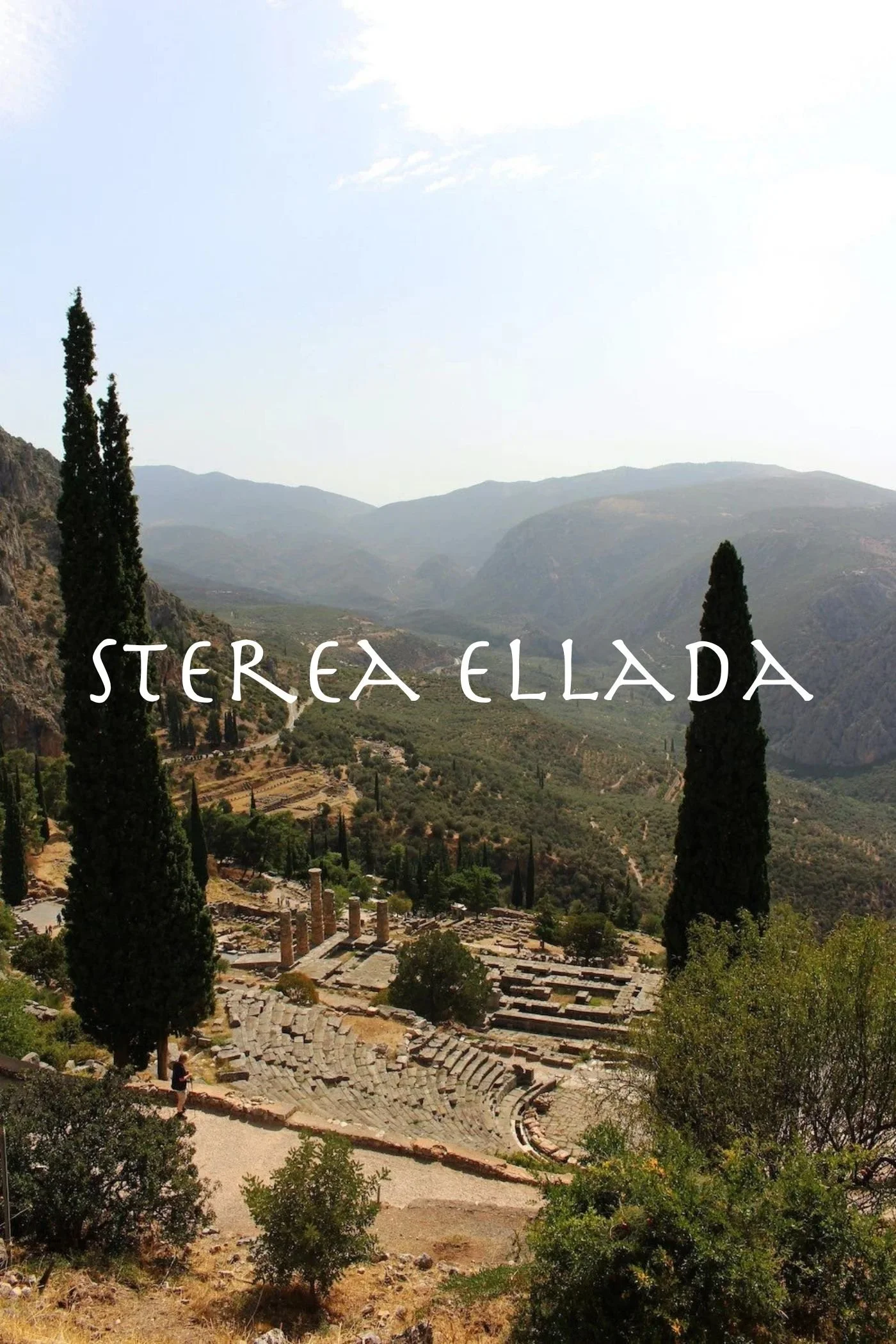
Different stories place Daphne in different regions. In one story, she is the beautiful daughter of the River Peneos, which is a river in the Vale of Tempe (Κοιλάδα των Τεμπών), which is a gorge in the region of Thessaly, between Mt Ossa and Mt Olympos (Mt Olympus). In another version of her story, she is actually a nymph of the River Ladon (Λάδων) in the Peoloponnese. And in yet another story, she is connected with the sacred site of Delphi, on the southern slopes of Mount Parnassos, in the ancient region of Phokis (know today as Phokida) in Sterea Ellada.
Click the play button to interact with the map
A Devotion

Related Articles




Transcript
You're listening to A Temple Wild: Episode 2: Daphne and Apollo
Hello and welcome to A Temple Wild, where we rediscover the myths of the ancient Greeks through the plants and landscapes that shaped them.
My name is Ekstasy and it is a rather cold and rainy day here on the mountain where I live in northern Greece and you know we often get these strong storms that come down off the mountain, with these incredible winds and one of my favorite things to do during a storm like that is to sit in our kitchen and look out at our garden where we have this incredible Bay Tree, this Bay Laurel tree, that grows against one of the walls in our garden. I just love to watch it dancing and moving in these winds.
For those of you who've heard of the Bay Laurel tree, most of you just call it Bay, it's often used as a culinary herb; that leaves are added to soups and stews. People sometimes grow them in pots and prune them into these interesting topiary shapes.
But in Greece, it does actually grow wild in ravines and woodlands, and it can grow quite quickly, especially if sheltered from strong winds. It's beautiful, an absolutely beautiful plant typically taking on more of a shrubby shape, but it can be pruned into a tree-like shape.
It's drought tolerant and aromatic, with smooth, dark green leaves and white-with-yellow flowers that provide nectar for honeybees, bumblebees, and solitary bees. It is Dioecious, which means that the male and female flowers are found on separate plants, and so it's only the female trees that will produce purple-black berries. So if you've ever seen a Bay tree and wondered, "Why is this flowering, but I'm not seeing any berries on it?", that's why; you've probably got yourself a male tree there. Which is the tree that we have in our garden, we've got this incredible tree like I said, I'm guessing it's something between thirty and forty years old, it's absolutely spectacular. We do have another tree close by on our property that is female and so that tree tends to produce berries later in the summertime, early fall.
So the Bay Laurel is also called Sweet Laurel or Grecian Laurel, Sweet Bay, or simply just Bay. It does have a special relationship with the Pythia, who is the Oracle of Delphi, and of course that Greek god that we all know, Apollo. It's an important tree for prophecy and for divination and its leaves were burned or chewed to encourage visions.
Perhaps the most well-known myth of the Bay Laurel is that of Daphne and Apollo. Daphne, whose name actually means Bay Laurel in Greek (Δάφνη), and in modern Greek when we talk about the Bay Tree or we talk about the Bay leaves to be cooking with, we do call it Daphne. So it's her story that we're going to be talking about today.
And she was a nymph in ancient Greece but different stories place her in different regions, or in different areas. In one story, she is the beautiful daughter of the River Peneos, which is a river in the Vale of Tempe (Κοιλάδα των Τεμπών), which is a gorge in the region of Thessaly, between Mt Ossa and Mt Olympos (Olympus).
In another version of her story, she is actually a nymph of the River Ladon (Λάδων) in the Peoloponnese, which is the southern area of Greece.
And in yet another story, she is actually connected with the sacred site of Delphi, which is on the southern slopes of Mount Parnassos which is in the ancient region of Phokis, also know today as Phokida in Sterea Ellada, so Central Greece.
If you want to hop over to atemplewild.com, I do have a map there so you can get a sense of where these stories are placed, where Daphne is coming from.
In this last location, as a nymph of Parnassos, that's to me the most interesting connection as it links her quite intimately - as we will see - with the Oracle of Delphi.
So like I said, we're going to be talking about her story today, between Daphne and Apollo, and I hope that you enjoy.
Daphne was a nymph, the beloved daughter of the River Peneus. Her only desire was to remain unmarried, content to freely wander the watery groves of her home with her fellow nymphs.
Some say that her grove was near Delphi, a sacred site of the primordial earth goddess Gaia - the mother of sky, sea, and mountains. And Gaia’s child, the great serpent Pytho, guarded the area.
When the young god Apollo, the new son of Zeus, arrived at Delphi with a desire to craft himself a place of worship, Apollo killed Gaia's serpent Pytho and claimed Delphi as his own sacred center.
Gaia, in grief and in rage, called upon Zeus to demand retribution for the death of her son. In response, Apollo was ordered by his father to undertake a series of cleansing rituals, the first of which sent him down into the valley to cleanse himself in the river to atone for his transgression.
But Apollo was proud after his victory over Pytho and when he arrived at the river and came across Eros — that small cupid of desire — Apollo mocked Eros, saying that Eros should leave large weapons like the bow and arrow to greater gods like himself.
“What, wanton boy, are mighty arms to thee,
great weapons suited to the needs of war?
The bow is only for the use of those
large deities of heaven whose strength may deal
wounds, mortal, to the savage beasts of prey.”
— Apollo mocking Eros, Ovid's Metamorphosis
But Apollo seemed to forget that even great gods as himself are not above the power of desire, so Eros responded to Apollo’s hubris by sending a golden arrow of desire into Apollo’s chest, and at the same time he sent a leaden arrow of repulsion into the chest of Daphne the nymph, so that the moment that Apollo laid eyes upon her, he would desire her just as strongly as she would be repulsed by him.
And indeed, when Apollo saw Daphne, he immediately wanted her. Pining and hungry, he sought her attention, but having already devoted herself to a chaste life of freedom, and being further repulsed due to Eros’ leaden arrow, Daphne was totally uninterested in Apollo’s advances and she withdrew from him.
Now another mortal, Leucippus, also longed for Daphne and wanted to be by her side at all times. Knowing she had chosen to withdraw from the company of men, Leucippus decided to disguise himself as a maiden so that he could join her retinue and get close to her.
But Apollo discovered this and in his jealousy that another man, mortal or not, should get so close to Daphne, Apollo encouraged her nymphs to bathe in the river, knowing that it would force Leucippus to disrobe and reveal his secret. Upon discovering that he was in fact a man, Daphne and her nymphs killed him for his deceit.
Apollo, satisfied that Leucippus was now gone and out of the way, continued his relentless pursuit of Daphne. He followed and chased her along the river banks, praising her beauty and growing in his lust. The more she spurned him, the more he wanted her. Exhausted and terrified, Daphne finally called out in desperation for someone to protect her.
In one version of the story, Gaia hears her call and opens the earth to swallow Daphne whole, placing a Bay Laurel tree where she once was. In another version, Daphne's own father, the River Peneus, transforms her into a Bay Laurel tree, metamorphozing her so she could forever remain chaste and rest peacefully beside the river.
Apollo, saddened by the loss of Daphne, but still joyous from his defeat of Pytho, declared the Bay Laurel his emblem and sacred tree. He cut a branch from her body and wove himself a wreath of her branches and returned to Delphi, crowned in self-proclaimed victory.
He built his own temple (which, according to Pausanius, was first made entirely of Bay Laurel) and established the Pythian Games, a yearly festival and physical competition in honor of Pytho, that Great Serpent whom he’d slain and whose death had required Apollo to go down to the river to cleanse himself of his transgression, where he met Daphne and this whole story began.
Because of this, the Bay Laurel became a symbol of ritual cleansing, but also of victory, first for the Greeks and then for the Romans. Many paintings, coins, and amphorae depict the laurel wreath as a crown of triumph. During the Pythian Games, especially, the victors were adorned with woven laurel wreaths and even today the “Nobel Laureate” and the “baccalaureate” are awards of distinction.
Once Apollo had taken over the sacred site of Delphi and established his center there, the oracle priestess of his temple came to be called the Pythia (named after Pytho, Gaia’s Great Serpent who had once guarded the site).
It is said that the Pythia would sit upon a tripod above a chasm in the earth, chew leaves from a Bay Laurel tree that was growing within the sanctuary, and shake a sacred Bay Laurel branch, all while inhaling the geothermal fumes emitting from the ground beneath her. And while in her divine trance she would utter prophecies, usually in the form of poetic riddles (very similar to koans) that would then be interpreted by the priests and the querents.
Most of you probably already know that the Pythia - the Oracle of Delphi - held significant power and that many famous prophecies were uttered by her (including that of Oedipus, the outcome of the Persian war, countless others) and her wisdom was used to make political decisions.
But before Apollo's temple was built, before the Pythia was established as a prophetess for the elite and politically powerful, it is said that there were three oracular Bee nymphs, called the Melissae, who lived in a cave on the slopes of Mount Parnassos, just above the sacred site of Delphi. And that it was those three Melissae who were responsible for teaching Apollo the art of divination. And, wouldn't you guess, that one of those 3 nymphs was named Daphni, the Bay Laurel.
In fact, Daphni was said to be the very first oracle of Gaia at Delphi before Apollo’s arrival, and the Pythia’s later use of the Bay Laurel in divination is possibly a thread from those older, earlier practices.
So we can see there is a close connection between the oracular Bee nymphs, the Melissae of Parnassos, and the Bay Laurel Tree. The Pythia was also later referred to as "The Delphic Bee," a nod to her origins as one of the original oracular Melissae.
And as I mentioned before, Pausanius says that the very first temple in Delphi was crafted from Bay Laurel, but the second temple was made by bees and was composed of beeswax and feathers.
In our next podcast episode, we're going to be returning to the Melissae and talking a little bit more about the bee nymphs of Parnassos, but I find this connection really important and really interesting as it seems to strengthen the role of the Bay Laurel as an important tree for divination and for prophecy.
The Bay Laurel is a sacred herb of oracles and a potent source of prophetic clarity and wisdom.
Woven into our daily cleansing ceremonies, in can be used for prophecy, divination, or cleansing. It lends its clarifying scent and warming nature to the clearing of spaces and the inspiring of oracular visions.
Regarding Bay Laurel’s other association with victory or triumph: Apollo’s “victory” over Pytho and his chasing of Daphne seem to me to indicate more of a cultural shift, where the new god (Apollo) comes in an usurps the older nature spirits of the mountain (Gaia and the nymphs and Pytho) by force.
For this reason, and also based on my personal experience of working with the Bay Laurel tree itself, I’ve never felt “victory” or “triumph” were really key powers or messages of the tree. So instead, I choose to refer to its other powers as a tree of prophecy and clarity and to use that in guiding my daily ceremonies and interactions with the tree.
But of course I encourage you to do your own connecting with the Bay Laurel to see what the tree has to say to you about its own nature.
I want to take a moment to point out that the Bay tree that I'm talking about is Laurus nobilis; that's the scientific, botanical name for this tree. It's important to note that because there are other trees that are also called Bay or Sweet Bay and those trees are actually poisonous and they look very similar but they have very different properties to Laurus nobilis. So it's really important to make sure that you're working with this specific Bay Laurel tree, the Laurus nobilis, when you are doing anything like cooking with it or using it for any of your daily ceremonies.
Always make sure that you're working with the right plant because some plants are toxic and can actually do damage to your body and in some cases even kill you. Not to get too serious for a second, it's always really important when you're working with plants that you know exactly which plant you're working with.
So dried Laurus nobilis leaves are delicious; wonderful in stews, soups, and casseroles. You can actually add them whole right directly into the cook pot. Usually at the end, after cooking with them, people remove the leaves before serving the dish, just because they can be quite tough to chew and are not typically meant to be consumed, only used as flavoring if you're cooking with them.
The dried leaves in your pantry should retain a really dark green color. So most of the leaves that you buy at the grocery store, if they're pale or brown, that means that they have lost most of their potency and flavor, and you should probably just add them to the compost pile rather than into your cook pot. So you want to really look for those dark green leaves.
You can use the leaves fresh, as well; they have a more delicate flavor and are wonderful for shorter cook times. I use the dried leaves when I'm making soup or stew that's going to be cooking for a long time, but I can use the fresh Bay leaves if you want to do a slow-warming dessert creams or slow-warming oil on the stove. You would use them the same way as the dried leaves, just put them straight in, warm them up in whatever you're making, and then remove them before you serve the dish.
The Bay Laurel has a very warming and slightly peppery taste, and is wonderful for use during the cold winter months. Herbalists traditionally use it, you can drink it as a tea to help with digestion, or add it into soups and stews for the same purpose. If you have a cold or the flu, the leaves can be used in a steam-inhalation, to clean out the sinuses, or the essential oil can be added to a chest rub for congestion. The hydrosol and the essential oil combine really well with other herbs like eucalyptus, rosemary, or sage, or even citrus. Like I said, it has that warm, slightly peppery undertone.
I personally love to use Bay Laurel in any ceremonies that I have for clarity or prophecy. The dried leaves can be wrapped into incense bundles or you can even burn them one at a time, and waft the smoke around to purify the air and purify your mind. You can use whole branches for ceremonial sweeping of your body and the space, especially after illness or prolonged periods of physical-psycho-spiritual congestion.
The woven wreaths can be worn as a crown over your third eye and the incense from the dried leaves can be carefully inhaled to encourage divination, especially prophetic vision or speaking or singing. Use the dried branches, which are still adorned with leaves, as a rattle for altering your consciousness or accompanying your divinatory utterings or any songs you like to sing during your ceremony.
You can also use the dried or fresh leaves as a divinatory tool for the casting of lots. You can write symbols or words onto the leaves and then cast them onto your altar or divinatory cloth. You can put them into a bag and then, after focusing on your question or intention, very carefully withdraw a leaf and interpret its symbol much like you would with a Tarot card or runes.
One of my favorite practices is to just sit beneath the Bay Laurel tree, entering into a state of calmness, you can inquire about your desire or question and then just sit there and listen. Listen to the rustling of the leaves, really feel the texture of its bark beneath your fingers, and stay open to any kind of messages that might be shared directly from the tree itself.
As with most of the plants, I love to have or write a small little devotion that I like to read, either before or during your cleansing ceremonies, or if I'm working with Bay Laurel in divination. So whether you're sitting before your altar or before the living tree, you can run your hands over the leaves and inhale that clarifying scent. And offer this up to the Bay Laurel tree:
Sweet Daphne,
sacred herb of the oracles,
impart your clarity
so that I may see divine wisdom
and speak divine truth.
Thank you so much for listening today; if you enjoyed this episode, I'd love to have you join our community as a monthly patron! With your support, I'm able to afford the tools and time it takes to write, record, edit, and publish these stories from the mythic Greek landscape. So if you're interesting in becoming a monthly patron, please do head over to atemplewild.com where you can find out more about becoming a regular supporter of the show.
Even if you're not able to financially support A Temple Wild as a Patron right now, thank you so much for joining me today in celebrating the mythic Greek landscape. If you'd like to download a transcript of the episode, leave a tip in our tip jar, or send me a personal message to say, "Hi," I would love to hear from you. You can head over to atemplewild.com.
I hope you have a wonderful day and I will see you next time.