Meet Linda Pappa
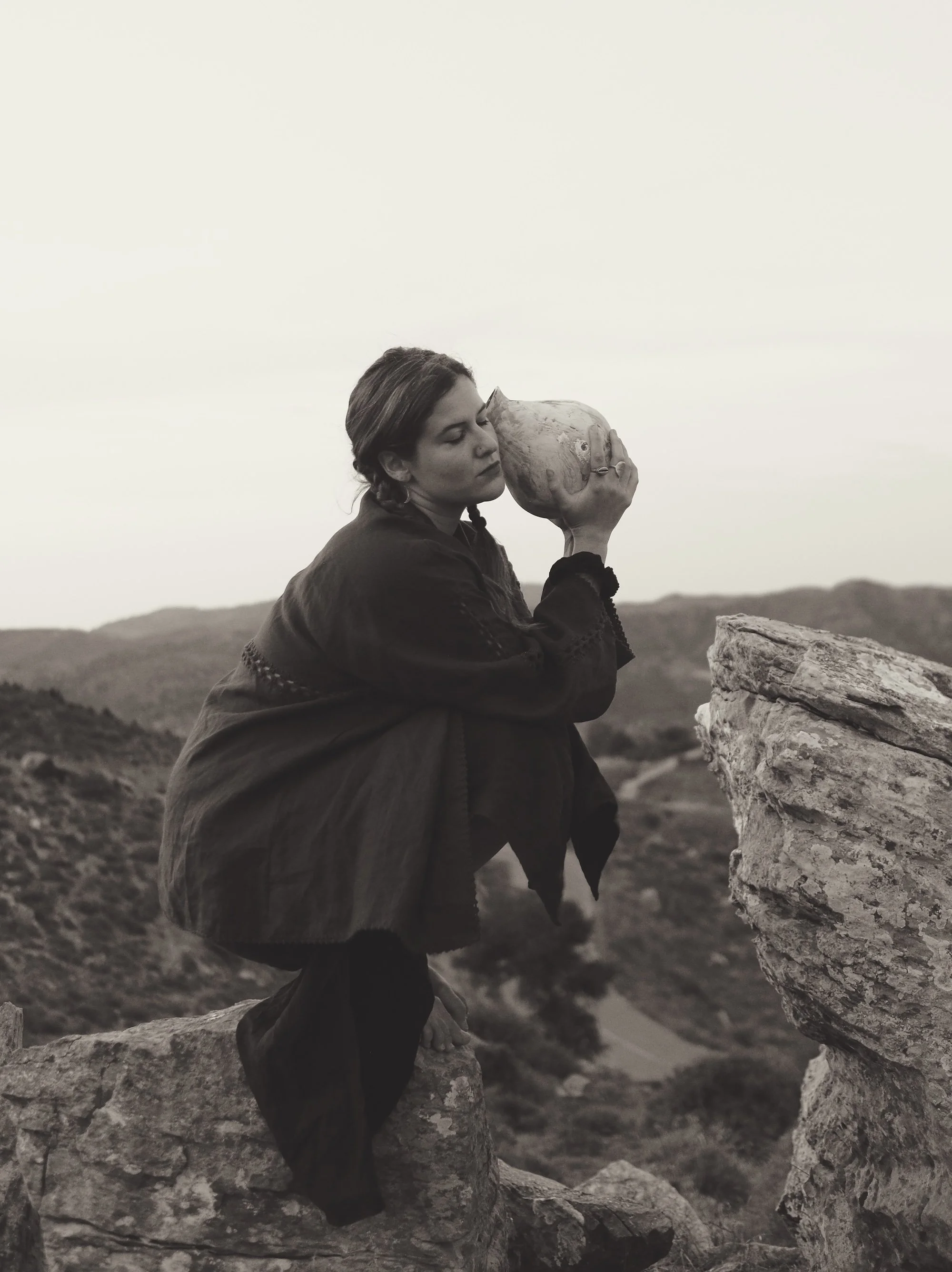
In today’s special episode, we meet Greek multi-disciplinary artist, designer, and ritualist Linda Pappa. Linda is based on the ancient island of Crete, where she has a home and studio in the mountains. She shares with us her artistic process: how she co-creates with the land, crafting ceramic vessels from wild clay she harvests herself and painting with pigments she makes from local plants and soil. Our conversation wanders into some really interesting places, including her reflections on village life, as well as the dark sides of living in modern Greek culture.
In her own words, Linda is pulled by a desire to explore the primordial energy residing in all living things. She crafts ceramic vessels from the wild clay she collects in the wilderness, paints images and talismans of visions received in meditation, crafts medicine in communion with plant allies, and enjoys writing about these processes, sharing what comes through in this sacred path of remembering. Learn more and connect with her at www.lindapappa.com and on Instagram @linda___pappa.
Listen below or with your favorite podcast provider
APPLE | SPOTIFY | Youtube | Amazon | DEEZER | PANDORA
Scroll down for show notes and the transcript.
Transcript
Mira: In this special episode of A Temple Wild,
Linda: I work a lot with materials that come from the earth, and that helps me a lot to ground into what that means to co create with earth. Every time that I, for example, make paint with Earth, with clay that I've foraged in the land that I've connected to, it takes me into such a deeper process.
And that process is really not about me imposing my ideas, it's like the material gets to speak through me. And it makes requests of how it wants to be used. So yeah, I work a lot with, with clay in all her forms. Making ceramics, uh, but also like making sculptural pieces that are not necessarily ceramics.
And making installations with clay, with raw earth. And I love to use earth as a, as a pigment. to make paint. It's a gorgeous, gorgeous material. And I love to work with, with plants also to have different collaborations with plants to make plant inks and different potions. And, you know, just really the idea is to have a creative practice that is more involved with the land.
And I love how this has taken a huge form since living here.
Mira: Hello and welcome to A Temple Wild, where we rediscover the myths of the ancient Greeks through the plants and landscapes that shaped them. My name is Mira and today I have a special guest on the show, the lovely Linda Papa. Linda is a Greek multidisciplinary artist, designer, and ritualist who is pulled by a desire to explore the primordial energy residing in all living things.
She is based on the ancient island of Crete, or Crete as we say in English, where she has a home and studio in the mountains. She crafts ceramic vessels from the wild clay she collects in the wilderness, paints images and talismans of visions received in meditation, crafts medicine in communion with plant allies, and enjoys writing about these processes, sharing what comes through in this sacred path of remembering.
I first came across Linda's work online about three years ago, and I attended one of her online ceremonies where she guided us through a creative visual art practice, inspired by and grounded in an experience of the earth. And I was just really moved by her deeply felt sense of the land.
And then a few months ago, after I sent out a newsletter about Dionysus and the vines, Linda reached out to me and asked if I wanted to lead a grape wine meditation as part of an online ceremony that she was going to be hosting for the harvest season. I immediately said yes, and it was such a beautiful embodied experience to hold space with her.
She has a very intuitive, organic way that she creates her art in relationship and cocreation with the land, which I find really inspiring and so I wanted to have her come on the show and share about her artistic process, as well as her experience as being half-Greek and feeling called specifically to move and ground herself in Crete.
So our conversation wanders into some really interesting places, including the dark sides of living in modern Greek culture. Linda has a poetic way of speaking, and I tend to feel a kind of buoyancy or joy in her presence. Whenever we talk, I seem to just giggle most of the time. That doesn't really happen so much in this conversation, but I hope that you find our conversation as inspiring as I did in terms of allowing a felt experience of the land, something grounded in sensuality in the body, instead of just an intellectualized way.
Also, as a small warning, we use adult language in this episode. So if you find that offensive or if you have little ones nearby, you might want to choose to listen to a different episode today.
So, with all of that being said, let's dive in and meet Linda Pappa.
Hello, Linda. Thank you so much for coming to A Temple Wild. How are you today?
Linda: I'm feeling good, a little bit tired. I feel the winter, is really coming over here. Although it's quite sunny. I feel my energy levels are like, ready. I'm ready to slow down and hibernate.
Mira: You're based on Crete, right? So is this your ancestral island? I mean, you're half Greek. What's the other half?
Linda: My dad is Luxembourgish. My mom is Greek. As far as I know, we don't really have any direct connections rooted in Crete specifically, from my mother's line. However, something interesting did happen when I was in Athens and looking through my grandfather's apartment. My great grandfather had a Cretan name, so it could well be that there is a thread with Crete. We definitely all felt it very strongly, that this land was just calling us, so, yeah.
Mira: And were you raised in Greece in general or in Luxembourg?
Linda: I was born um, in Luxembourg. And, I spent my childhood and, yeah, most of my youth in Luxembourg. I studied in Brussels for a little while, so it was, you know, just always being in that part of Europe for most of the time. I would come back to Greece every summer, every Christmas, you know, we would go to see family, I had my grandparents here that I felt very close to and they were close to Athens and Corinthos. So we would go to Greece mostly on those occasions.
Mira: And what was your experience of the landscape at that point? Were you really aware ofconnection with the Greek land? Or was it more just like, oh, I'm on vacation and this something different and fun?
Linda: For sure there was that feeling of like, oh, I'm on vacation and I, with the, here are my friends and I can play all the games that I like to play. And, but, I did get very, very nourished by the landscape. Actually, my grandfather, one of the, the places that he was living was near Corinthos and in the summer, this was a building that had a orchard around it.
And I have these memories of my grandfather, you know, taking care of the building and taking care of the orchard that was, you know, he really was contributing to the community in this way, you know, taking care of this orchard that was between all of the buildings. And, I still have the memory of the, the smell of the, the wet soil when he was, putting water to the orange trees and to the olive trees and as a kid that was such a beautiful place to hang out just being amongst the trees in this big beautiful orchard, you know, between apartment buildings, nonetheless, but it was people that this was there, you know, and it was very close to the sea.
Yeah, I remember how the wind felt, in the summers. feeling this wind going between the tree branches and hearing the rustling of the leaves. And then these stronger winds, the meltemia, you know, that would sweep everything. And, yeah, that was like very sensorial. And little things like, you know, being curious about the prickly pears that were growing along the edge of the of this orchard, or my grandfather giving me raw almonds to eat from the tree. And just the taste of those raw, very green almonds in the summer, they're not fully ripe yet, you know, but they're like really different, really raw, almost like an amaretto or marzipan, you know, like really that strong almond flavor. I felt very, very connected to that.
Later, when coming here to Crete something that just really made me feel at home here right away was the, the smell of the wild herbs that are all around the landscape. There's just such an intense herbal smell.
Mira: Mm-Hmm.
Linda: in the air, especially in the summer when we first started coming in Crete. It was mostly in the summer. Just visiting, just coming on vacation. But with this heat, you really smell the herbs.
Mira: Yeah, Yeah, the sun is evaporating all of those essential oils, and it just smells amazing. Yeah.
Linda: Exactly. Exactly. It was so powerful. And then just smelling, just going close to those plants and like rubbing them in my hands. I'm smelling them. It's like, whoa. It's really as if the land was, calling me to go deeper there, you know?
Mira: Yeah.
Linda: Yeah, a long journey, but yeah, I'm here now.
Mira: Well, so can you, can you kind of bring me through that long journey? I mean, how did you end up, you know, spending some times here in Greece to deciding to make this your home?
Linda: Been living here for six years now, in this house, in this village, but I've been coming to Crete for many, many years. it must be like over 16 years now that I've been coming to Crete. Yeah, my parents actually, started coming to Crete, especially my mother really felt drawn to come to the island because of her yoga practice there was actually, like a yoga shala in the south of Crete that she was interested in going to many, many, many years ago. And I was just a teenager at the time and I followed her on a few trips. And it was just a really beautiful time, you know, just to come, just us, mother and daughter, be here, find ourselves in the middle of nowhere, in the wilderness, in this very wild south part of Crete.
And that was you know, in a moment where things were evolving and changing with the situation of my grandparents. They were not anymore in a state where we, we could, you know, go and stay with them as we used to. There was this transition then that they were getting quite old. And that changed the way, the way that we would come to Greece. And Crete just opened up this new space of coming back to the motherland, but not necessarily being with relatives. Just experiencing another layer of what that means. And it's funny, you know, now that I think about relatives and the word relative, we, we speak about relatives as like, you know, our fellow humans, our family, human family, but I realize now that I have so many relatives here, non human, the plants, the land.
I mean, if you would have told me this like 16 years ago, I would think like, no way, you know, what are you talking about? But this whole journey has led me here to understand things that are way deeper about this sense of belonging. Yeah, it's been a long journey. It didn't happen like, instantly, as I said, we've been coming for 16 years on Crete and there was this relationship slowly building up, like, okay, let's start going to Crete a bit more and spend our holidays there.
And in the meantime, my partner and I, we started our business. We were living in Luxembourg. And then at a moment we started traveling a lot and we were living nomadically so this journey took us in many different places around the world. Basically we were just living and working from our laptops, that's it. Just, going from place to place. And what was driving us then was just simply the, the curiosity of experiencing different places, different cultures. We spent a long time in Asia, for example, in Japan and in Thailand.
Mira: Wow!
Linda: We went all the way to Australia, like, we lived in so many different places and it was all so beautiful and so exciting, but in the meantime, you know, there was this as at the same time as this excitement builds from, you know, constantly moving and like reinventing yourself and, and getting all this input, which is so beautiful, right? But at the same time, there was this other side of like, woah. There's no time to integrate all of this. Wouldn't it be great to look for a base somewhere?
And when we asked ourselves that question, we were in Japan, in a sweet little tiny house that we loved, and it was that house that just made us ask the question because we loved being there, we just realized how beautiful it is to feel really at home somewhere.
And when we asked that question, it was like, Crete was calling us, basically to come, and it's like, Yeah, okay, there's a feeling that there's a home for us in Crete, and we've just felt so really something potent every time we were coming here all those years. Even if it was just for a few days, it was really just the power of the land and how, just how it shifted things from inside out, you know, like giving perspective and getting you out of ways of thinking that were maybe hindering you in the past, you know, every time we would come to Crete, we would feel that. So it made sense, you know, that Crete was calling us when we asked the question.
And for me, you know, I'm only really realizing now that, yeah, there's been a thread there about, you know, the land calling me to connect also to ancestral threads. So even if as I mentioned, I, as far as I know, I mean, maybe, you know, this story about my great grandfather, right, but thus far, I didn't know about any relatives specifically being in Crete, but it's just this idea of, not this idea, but just that, that, that feeling of, returning to the motherland, regardless that there is a mother-like connection to these lands, and that has been really shown to me over the last few years that, a lot just wants to be woven there because I do have roots in the Mediterranean, in these lands, in, like, those, those trees, this earth.
I know it somehow, not, maybe not even from this life. Sometimes it really also gives me the feeling that I might have spent past lives also here. So this is like, it's a continuous, portal that keeps opening and that I keep feeling into like, it's just, I, my life has been just completely transformed since, since I followed the call to live here.
And it's been so full of lessons and experiences. Yeah, that would take like hours to describe.
Mira: That's so beautiful. Thank you for sharing that. And so how has your art practice evolved since you've moved, since you've moved to Crete? I mean was art something, the visual arts, was that something you'd always done since you were a child? Or did this kind of sprout out of finding this base in Crete?
Linda: So I had been, creating and having an artistic practice indeed since I was a child, and, I have to say I'm really grateful that this was encouraged in my family. My mother was, um, and she still is a painter. It's just been really nourishing to see her work, even if that was not the way that she was making a living, not at all. It was just the devotion, you know, and how much richness that it brought to her life and how many spaces that are beyond, um, the mind, you know.
Her painting practice is specifically about abstraction, and it keeps teaching me about, you know, letting go of ideas. And, yeah, that has been a huge inspiration for me and I've always had some kind of practice, you know, being present in my life, phases that I went through, you know, like having made, really intense collages as a teenager, for example, and doodling and drawing and then making murals at people's places and going at festivals and, like, making huge paintings over the whole course of the festival, art installations and lots of things.
These practices all opened me up to, you know, following what my creativity, can, can lead me into, you know, those inner spaces, you know, that are not quite comprehensible, but that are led by spirit and, you know, connecting the dots between different things that are being woven in the unseen. So at the time I didn't know how alchemical it was, you know, now I have a bit more background on the spiritual aspect of it, but it's so powerful really, like, yeah, what it can do just to follow those threads and to create and not really have an aim.
But yeah, something that really transformed for me when coming here to Crete was how these art practices then shifted to include and involve the presence and collaboration with Earth. So that, that has been, I don't want to say the missing piece, but it was just what needed to happen, you know, at this point in my life, it was like, okay, here you are, like, I've been waiting for you, you know?
Mira: Yeah,
Linda: Have you've been waiting for me?
Mira: Yes.
And so for someone who's not, who's not familiar with your work, I mean, how does that translate into a physical practice for you?
Linda: The way this manifests is basically like, the main difference that I've noticed also in my artistic practice the last few years has been that I'm not guided anymore by ideas and outcomes and, you know, things that have to do with the mind making images and then thinking like, "Oh, I want to recreate that, that I just received in my mind". Or like just that curiosity that doesn't really have a grounding point, you know? Working with earth means that I feel into the landscape and in the way that I do it is basically I work a lot with materials that come from the earth and that helps me a lot to ground into what that means to co-create with earth because it's, it's really instead of working with artificial paints, like, you know, things like that, which I still do use, but every time that I, for example, make paint with earth, with clay that I've foraged in the land that I've connected to, it takes me into such a deeper process. And that process is really not about me imposing my ideas. It's like the material gets to speak through me. And it makes requests of how it wants to be used. So yeah, I work a lot with, with clay and all her forms, making ceramics, but also like making sculptural pieces that are not necessarily ceramics and making installations with clay, with raw earth.
And I love to use earth as a, as a pigment to make paint. It's a gorgeous, gorgeous, material. And, I love to work with with plants also, to have different collaborations with plants, to make plant inks, and different potions and, you know, just really the idea is to have a creative practice that is more involved with the land.
And I love how this has taken a huge form since living here. And it's also something that I take with me if I travel somewhere. You know, I am always curious about, okay, what's the color of the soil here, and can I maybe work with it, and maybe is it, is it calling me to do something with it, and what materials are available here, and what plants are, available, and how, how do they feel, and, what is there to find out about them? And it's really like a creative practice that's a lot more about relating and collaborating with nature, with earth, rather producing specific things.
Mira: Yeah. I'm curious if you can talk a little bit more too about, on a daily basis, do you have like a ritual practice or do you do something, you know, sort of in a structured, regimented way, like, every morning I wake up and I go and I do this. Or is it more that you allow every day to kind of be called organically to a task or to a creation?
Linda: Second thing. Yes, absolutely. That's, that's more my way, it's to allow. And yeah, the, the last few years I've just learned a lot about just the ways of the feminine because having had this opening, this curiosity towards Earth made me realize like, okay, this is something that has an energy that feels way different than, you know, this, this whole mindset that we have been, you know, brainwashed with. Not to say that masculine energy is bad in any way, but, you know, there's just been an imbalance, you know, always structuring things, always coming with outcomes, it's, it can mean that there's no space for just receiving and seeing how the world around us just wants to, to penetrate us, you know, to be absolutely immersed in, in our processes, for us to immerse ourselves in the world and the world to immerse itself within us, if that makes sense. So, yeah, it's, it's a lot about, this allowing and creating spaces and, you know, I'm not gonna lie and say I'm perfect at doing that because I'm still, you know, sometimes struggling with the, the concepts of, you know, having to run a business and, you know, just being in the world and having to feel like I have to structure my life, you know.
And I love to do lists, you know. I love structure. I'm actually, I'm one of those people that really enjoy structure, but the creative practice is always teaching me to like, okay, now maybe you just need to make space. Maybe you just need to let go, and something's going to come through. You're going to observe what plants want to speak to you, that this or that day you notice that particular fruit tree that was always there, but you never really took the time to notice it and that day was the day that it needed to speak and just to go deeper into relationship with it like hello yes you are there, I acknowledge you cool let's create something together.
Mira: That is so beautiful. Yeah. Yeah. Do you, do you feel right now at this season in your life, do you feel particularly called to a specific plant or a tree or an herb or even an aspect of the landscape? I mean, that you just sort of hear repeatedly? You know, kind of calling you and pulling you towards it right now.
Linda: There's been a lot of plants that came to my life this year, like the Rose, the Grape, the Pomegranate. But like now, specifically now, the last few days I've been noticing the presence of Sage. Basically, I just harvested a bunch of Sage from my garden and, yeah, I'm just noticing the difference that it has with the, the Sage that's growing in the wild.And I just feel, you know, quite connected to it simply because it is in my life right now. And, I was, it was a little bit wet. I had, uh, just harvested it and dried it, but it was kept in a little bit of a wet condition. And I put it in the, in the oven in low temperature to let it dry out slowly. And the whole house smelled of this Sage scent. And that created the whole language and I feel now very called to gather my Sage bundles of wild Sage that I've gathered through the year and, yeah, to get more into a ritual of burning them around the house, around myself. It makes sense that she comes now, even though I connect to Sage all year round. There's so much Sage here in Crete. This beautiful wild Cretan Sage also growing everywhere in the mountains and she's so potent. But yeah, I feel like she wants to to be more present now because I have some things that I need to clear and purify in order to make space for new chapters in my life, in my creative work, in my faith, in my relationships, everything. I'm in a bit of a threshold right now, so it makes sense.
Mira: Do you do you feel comfortable sharing more about that threshold that you feel like you're on?
Linda: I feel that I'm ready to let go of this need to occupy my time and creative practice with a lot of different things. Small things, because I realized that it, by doing a lot of small projects, it stems from, you know, this, this patriarchal way of, like, needing to produce a lot and put out a lot, because, like, oh my goodness, if I don't, then how will the world know that I'm doing anything at all? And yeah, I think I'm coming to terms with that pattern now and I'm ready to invest my energy, you know, I see it a little bit like, you know, someone who maybe was spreading their energy horizontally, you know, like crawling in every direction horizontally and spreading oneself too thin to rather direct this energy vertically. You know, allow more centering, more centeredness, and, you know, even cutting cords where they need to be cut, and allowing time and space for longer projects, more devoted projects to, to emerge. I've always been like a bit skeptical about like what it means to be an artist that like just does huge pieces and things that are, you know, that have a certain format. The last few years I've been producing a lot of stuff that's like smaller, still very ritualistically. You know, I have to mention that like I, thinking of producing things, I still go into a certain degree of like ritualization of the whole process, but I just did a lot of smaller things the last few years. And I think I'm ready to move into slower, larger, more devoted ways of, of creating. Yeah.
Mira: Wow.
Linda: And more mystery. Yeah.
Mira: Yes.
Linda: More feminine darkness, less visible processes.
Mira: And so I know as part, as part of your creative work, I mean, you also host rituals. I mean, we, we did one together, what is it? Almost a month and a half ago now, which is amazing. I can't believe how fast time has gone. Um, but do you, do you feel like that is something also that kind of came organically out of your work with the earth that you felt called to lead other people in this relationship with creating with organic materials and, you know, how did you, how did that sort of evolve as a piece of your, of your work and your path?
Linda: Yes, the community part has always been a huge aspect in my life, even having worked on other projects before my own. Like in Luxembourg, for example, my partner and I used to have a community project that was, you know, very much based on sharing things with other people and in that scenario was like about living more mindfully and living in a more connected way, and creating those spaces where this kind of sharing is encouraged.
So I just love that so much. And I, you know, it's, it's a huge part of what nourishes me because I do feel that, you know, I'm not exactly like a hermit. I can be. In certain moments when something big needs to come through me that I need to slow down and just like not engage with the outside world, but really, I love the spaces where sharing is encouraged and just to witness myself through others.
We all witness each other through each other. We are all each other's mirrors. And it's so, especially when working with things that have to do with, you know, relating to earth and creating in this shamanic, animistic way, it's so beautiful to see how everyone interprets things and really create openings for everyone.
So yeah, I started to offer these spaces actually during COVID because there was like a strong need, you know, to just stay connected, to be having those spaces of creativity and intimacy and, and spaces that offer, you know, that deeper connection with the elements and, like, journeying through the year like this is really beautiful, just to have certain moments in the year where we get together. Even in a Zoom meeting, even, you know, it's so powerful, it's really like as if we were in the same room together still, and so much can be shared, I really love that, and I'm, I'm exploring this as well right now, how to do it in a more, more devoted way. Less about doing something every once in a while, but like, how can it, you know, more devoted, more present to create, to weave more intimacy also between people. To be able to really connect deeper because we see some people come to many of the gatherings and it's like, it's so beautiful to connect to each other in that way when we see each other again and again and again. Journeying through all these things together. Yeah.
Mira: Yeah. Do you, do you find that people are drawn to you specifically because you, your work is based in Greece and because your work is inspired by the Greek landscape? Or do you feel that people are, are more drawn to, in general, your connection with Earth and your, your intuitive artistic process?
Linda: I'm still asking myself that actually, because yeah, there are those, those, different aspects to it. Like indeed the, the Greekness does create and influence the visual language also, and the textual language that like this specific language of the earth here, like the stuff that I share, you know, being here on an island on the, on the island there's the visual language of Crete, you know.
Mira: Yeah, exactly.
Linda: Big mountains and cliffs and, and this red earth and the ocean and the tide pools and just all this magic, and I am also in quite deep relation, especially the last few years now that I've grounded even more here, I'm in always deeper and deeper relation with what it means to be here in Greece, on land, in Crete, and learning from the culture here also, the locals, the people, their food, the life in the village, and I share a lot of that. So yeah, there's a lot of that in my presence, I guess. And I use Greek words often when I name artworks and publications and so on. But yeah, deep down, it is about looking for that, that thread to earth. I see that I am, I'm sure that some people come to me because of the, the Mediterranean land and the Greekness. But I also just generally feel that it is simply about this earth connection and that's really like the backbone of what I'm here to share. And, you know, I'm not, I'm not saying I'm going to move from Crete anytime soon, but if it does happen, if something happens in my life that it means that I have to move and go somewhere else, I'm still gonna want to live by the principle of devotion to Earth, and co-creation with Earth, and relate with the non human world in this way. Yes.
_____________________
Mira: So I want to ask a question that might be a little, um, um, well, okay, I'll just ask it.
Linda: Yeah! Go for it.
Mira: We'll see how it lands. So, you know, I think sometimes at least for me, there's this romanticizing that kind of happens inside of myself in terms of my relationship with Greece and the Mediterranean and, my Greek roots, and, you know, I definitely lean into that in my own work and, you know, my presence online and all of that. And, you know, I think it's, it's so beautiful to be able to share that deep connection and that, experience with people, but then there's also the sort of, I don't want to say like the dark side, but the, the intensity of like the reality of living in a Greek, in Greece, in the Greek culture and, you know, the, that, you know, there is a disconnection on a lot of levels here, I think, with the land, and, and so I guess my question for you is just, you know, what, what are some of the challenges or those, those maybe dark sides that you've experienced living here? And how would you hope to maybe see them change or be different, or maybe you don't want to change them, maybe it's just accepting that that's just how it is here, but if, if you wouldn't mind sharing more about your, your experience with that, that harder struggle, the reality, right?
Linda: Yes.
Mira: Like everything has light and dark, so.
Linda: Absolutely. And I love that we're bringing this up because yeah, I've been doing quite some work and like, dismantling a little bit the illusion and my own illusions that I might have gripped, gripped on. And I mean, living here like, really living here and having a home here, that has been an initiation by itself on the, yeah, the ups and downs of the reality of really just being here, absolutely. So there's different layers to that. And for me, there's the simpler things like, for example, coming from Luxembourg, you know, I did not realize my privilege and just how efficient things can be in Luxembourg. And in Greece it's not all the
Mira: Nope.
Linda: same case.
Mira: That’s putting it very politely and sweetly, Linda.
Linda: Very sweetly. Shall we just say it's a shit show?
Mira: It's a fucking shit show.
Linda: Like, going to the bank here is a trip. It's like going to the, like, the jungle, and even the jungle would be better suited, you know? I mean...
Mira: Yes. Yes.
Linda: It's very chaotic and intense.
Mira: Yeah.
Linda: Having to work through that has been interesting, very, I mean, I've been initiated over and over and over by those experiences to also like touch into the more tough parts of my being, you know, like.
Mira: Yeah.
Linda: I came here as a people pleaser, maiden, smiley-faced girl, you know?
Mira: Yeah.
Linda: Who spent most of her life in Luxembourg. And I come here and I have to, like, I have to be tough, and I have sometimes I have to yell at people. And I have to call people on their phone and run after them, you know?
Mira: Yes.
Linda: To ask for what we spoke of and waiting for people to show up, like, renovating a house in Greece?
Mira: Yeah.
Linda: Like, we could do
Mira: No.
Linda: a whole podcast about that.
Mira: Oh my god. Yeah.
Linda: Yeah. Thank goodness most of the renovations were taken care of by ourselves.
Mira: Right.
Linda: So that, that saved us a lot of hassle from, you know, dealing with different people, but, you know, the few people that you do have to deal with, like, you really see that things are very different. You have to run after them, you have to call people, like, there's a whole other way that things work, and it's not to blame anyone, of course, but it's just... you know, it's this whole new thing to get used to. Now I'm used to it. I'm fine. I'm like, okay, you know, this person, like, of course, I'm going to have to call them. I'm going to have to run after them. Like,
Mira: Right.
Linda: that's how it works.
Mira: Right.
Linda: You know, we don't set an appointment for things.
Mira: No.
Linda: So more 3D practical things. Um, and then, you know, there's just, you know, that, that sense of grief and despair sometimes from watching what's happening to the, to the village and to the, this culture of, of village life that was, oh my goodness, like the village that we live in, it's inspiring. It's both inspiring and heartbreaking to hear the stories that the elders tell us about what life in the village used to be. And, you know, they tell us that there were so many children, and there was a school, and people were riding donkeys, and there was a well, and everyone would meet at the well, and there were fruit trees, and people running around, and not just one cafe, but like four or five and it seemed like it was the place to be and and people were were sitting together and singing until the late hours and creating μαντινάδες, the, you know, this, this Greek, this Cretan Cretan specifically Cretan songs, poems, you know, the sung poems of the land here and, yeah, just so much of that is getting lost because people, you know, people have moved to the cities and I say that as a privileged person who again came from Luxembourg and had the money to buy a house in the village here, the locals here, that we know, for example, who are our age, that come from the village, they could technically live here because their families are from here, so they would have a place to stay, but it's just that they wouldn't be able to work from here, you know? There's this whole other attraction from, you know, going to the city and having the commodities and so on. It's just like all of life has moved and shifted in this way, people's perspectives on what it means to be in the village, it's like, you know, many, oftentimes I speak to locals here, and they're like, Oh yeah, but what are you doing in the village? You know, like they don't even understand, you know, like my little dream thing that I'm doing here and having an art studio and you know, wanting to buy land to have fruit trees.
Mira: Yeah.
Linda: Although every once in a while I meet someone who says like, wow, wow, it's so beautiful what you're doing and we connect, you know,
Mira: Yeah.
Linda: Then I ask them about their stories and we connect even deeper and, you know, about this love for this, the simpler life and and the land. so yeah, many, many, many things are getting lost and grandmothers and grandfathers who not only the had, they don't only keep the stories, but they keep also the wisdom and knowledge, many of which have knowledge about, you know, plants and healing, you know, this folk ways of healing, like really, really coming from this deep relationship to the land that's been there throughout countless generations. Yeah, it's, you know, oftentimes people die with those things. That causes a lot of pain for me, I have to say. It's really, you know, it feels like I'm still, like, gripping here on what's still there, but, like, it's crumbling. I know it's crumbling, but I'm still sort of holding on to it, trying to say, like, I love you, you know, like, and I want to share you, like, please don't crumble just yet.
Mira: Yeah.
Linda: I want to be inspired from you for what I'm creating and eventually like transmit that somehow and save a little bit.
Mira: Yeah. Yeah. That's actually exactly what I had another guest on the show, Maria Christodoulou, who's an herbalist based in Athens, and we were talking about this exact same thing and how, you know, people are leaving the villages and going to the city. All of this knowledge that the elders carry is, is disappearing, you know, and yeah, and we were just lamenting that and how there are, there are a few people, I think, who are trying to gather those stories and trying to keep alive and hold on to it and try to, to bring that knowledge into the new generations. And I'm hopeful that there are more people like us, you know, who are returning to the smaller villages and who are trying to learn this, these things so that we can pass it on and keep it alive because I don't want it to disappear. You know, I don't want it to crumble. There's so much wisdom to be to be passed down and to learn. And I mean, we can learn it all again. I mean, you know, we're humans. I think that's one of the most amazing things is if we can remember our connection to earth, we intuit and we learn from the plants directly, we learn from the landscape directly, but, you know, why reinvent the wheel? If we have elders, you know, who have so much wisdom that they can share and, and then we can pass on also to the next generations. So.
Linda: Absolutely, absolutely. Yeah, it's really humbling to notice that, you know, when here in Crete, thankfully, there are some communities and some contexts where tradition is preserved so beautifully, sometimes even in a bit of a rigid way. It's interesting because they, you know, there are a lot of Cretans who are absolutely proud of their heritage. And it's so beautiful to be in their presence. Like I just, I just came back from um, a workshop, a seminar of five days where I got to learn the ριζίτικα songs of Western Crete. Um. Ριζίτικα are basically songs that have, you know, taken root in the mountains, in the feet of the mountains, all around in the villages of Western Crete, around Samaria and like Apokoronas, Chania is mostly the region where they have emerged. And it was so amazing to learn those songs with the men who were taught the songs. Those songs that were passed from generation to generation, like really a true oral tradition that we were exposed to. And they just told us so many things. It wasn't even about the songs. It was about the way to gather and the, the order and the ritual aspect and how those songs were made and how they were sung and what they mean. They, they can be about different things, about war, about love, about greeting someone into a gathering, about weddings, about everything, everything. It's so rich. But yeah, there too, there was a little bit of grief because when they were, they were telling us about how those songs were passed down, um, basically people were learning the songs by sitting together in a village, you know?
Mira: Yeah.
Linda: Like it was, there was not much else to do.
Mira: Yeah.
Linda: They were telling us, you know, if you wanted to be, um, part of a, of a crowd, you know, of a group, a παρέα in Greek, you know, if you wanted to be part of the παρέα, you have to either know how to dance, how to sing, or how to be really funny and tell good jokes, you know, that's how you become initiated.
Mira: I love it.
Linda: So, you know, it's not just about sitting and saying random stuff, you know, it's about like being in this community way of entertainment, you know, and entertaining one another in the village.
Mira: Yeah.
Linda: Deeper in this way. And so many, many of them chose singing
Mira: Yeah.
Linda: because it was like, they just love to sing. And the songs were passed generation to generation, just being sung in groups. Someone would hear them. And then eventually they start to sing them too. And then they pass them to the other group and so on. It's so amazing. And yeah, that's the part that's a bit heartbreaking for me. Because I'm like, when would you see a gathering like that? And a kind of sharing like that? I mean, it feels almost like, ah, it's so intentional, you know, but it wasn't, it was just the way to be.
Mira: Yeah.
Linda: You know, in our age, this, this age that we live in, that's so fueled by technology, that would sound like, oh yeah, that's a thing, but you know.
Mira: Yeah, and this, the whole conversation just makes me go back to this thing that I think about a lot, about the contrast, I guess, between traditions and trying to keep alive something that's been passed down from generation to generation versus, on the other hand, innovation or creativity or new, new traditions that get formed and, you know, I, I spoke before about kind of romanticizing Greece. I think sometimes I'm, I'm also, you know, guilty of romanticizing the past and romanticizing even traditions in general, because, you know, they're also some really shitty traditions, some really awful things that we don't want to, you know, continue and bring forward.
So, you know, it's, it's always for me, this like discerning process, and I love what you said about how, when you went to this, this workshop, it was more about them teaching you how to come together and create this experience, not necessarily just memorizing a tradition or memorizing a song and more inviting you into an organic process of how as humans we continue to create, you know, tradition, create story, create our future together, you know, in the moment. So.
Linda: There are things now, if we wanted to carry on this certain traditions, we would have to update them anyway.
Mira: Right.
Linda: and that, that can be a beautiful thing. Like, for example, these Rizitika songs that I just told you about, they are normally mostly sung by men, or at least as far as we know from how they were preserved, it doesn't mean that the women were not singing, but they weren't doing, they weren't allowed to often do that in the context of a group, you know, it was, they would have to get permission from their husband or brother in order to sing, which tells you a lot about, you know, that, that, that side of patriarchy that's like, it's not welcome now, you know, we need to change that narrative.
And it was interesting to be in that seminar and to notice that, Oh, cool. Like most of us are actually women. And this is awesome because this is a tradition that was mostly about men singing. So we are actually changing, evolving the tradition, where by it being transmitted like this to us, that's like, wow, it's like a new age of this tradition and it was, yeah, it was really potent to hear those songs from men, but then to, to sing them, you know, with this level of intensity, like, as a woman, and I just know in my bones that women were meant to sing these songs. It's just that they were not allowed and they were not shown. Yeah, it was always hidden, so now it's it's a new age and it's very beautiful to experience.
Mira: Yeah, and I also wonder too about for men, you know, what their experience is in terms of having new transformations or new traditions that they can carry forward here because like you were saying, you know, it was mostly women there at the, at the gathering. Like, I wonder, you know, are there a lot of men who are also coming back to different sort of reclaiming and changing and carrying forward old traditions into a new way, you know, and what that would
Linda: Yeah.
Mira: that look like for them, you know?
Linda: Definitely, definitely. Yeah, it was mostly women, but there were also quite a few men and yeah, like young men, you know who are into music and I'm sure that, you know, there's that part of like reclaiming but also this desire to create something new with something that's very old. Yeah, I'm excited to see how that's going to inspire, you know, everyone that I was at that seminar with.
Mira: Yeah.
Linda: It's so beautiful to be in such spaces because, yeah, they're like portals between worlds, basically.
Mira: Yes. Yes. I love that visual.
Well, so, bringing it back to your art and your creative practice and where you feel like you're standing on this threshold now, moving into something maybe new on the other side. Is there anything about that that you want to share with us about where you see it going?
Linda: I feel very called to create a body of work that will be forming not just throughout, you know, one small phase of my life or normally my cycles can be quite short. From the moment that I have an idea, to the moment that I source the clay and that the pieces come alive, these cycles can be quite small, so I'm just longing for longer cycles. Cycles that last several years, maybe.
Mira: Oh, wow.
Linda: Yeah, I'm looking at working, creating a body of work that, that I will give myself time to, to really give life to. Yeah, to create something that's, that's even deeper than than an idea that really comes from a, a process of connecting with a land, and to something that's more mystical, more dark and wise and, uh, and even more ancient.
Yeah, I feel that there's something pulling me now to go there, to go inside the labyrinth. And, yeah, and swirl around and get lost and see what, what's on the way there and, and eventually come out when it's time to come out, uh, but not to force it to align with whatever schedule or timing that the world expects of me, you know?
I dream of, of creating an experience, something that's, you know, maybe it's an exhibition, maybe it's some kind of installation, maybe it’s something experiential, you know, but, yeah, really want to create an experience that's, it's not just based on the art pieces themselves, but about what can be felt in that space. Yeah.
Mira: That's beautiful. That's beautiful. If anybody wants to follow along with your work or to, you know, stay in touch with you, where should they find you? How's the best way to connect with you?
Linda: So, I am quite active on Instagram. You will find me @linda___pappa. It's linda, l i n d a, three underscores, p a p p a. And then, I have a website, that I, yeah, that I update regularly. There's my shop there as well. I have my ceramics and my publications and I announce events and different offerings there. And I have a really sweet newsletter that I send out as well.
Mira: Yes. It's like poetry, receiving your letters is like receiving a beautiful piece of art. So I highly suggest that everybody sign up for your newsletter. Definitely.
Linda: Thank you. I was just thinking, too. I have so much to share. It's time that I send another one soon.
Mira: Yes. Yes. Beautiful. Well, thank you so much, Linda, for being on the show and talking with me today.
Linda: Thank you. That was really lovely.
Mira: Yeah.
Thank you so much for listening to this conversation today.
Looking at Linda's vessels and her photography and paintings and reading her work, it's like drinking from the land. I feel nourished by her work, and I hope that this conversation gives you a little taste of her artful presence in the world. So please do definitely visit her website. If you enjoyed this episode, please be sure to like and follow the show wherever you're listening as it really helps other people find A Temple Wild.
If you'd like to support my ability to keep making episodes like this one, as well as all the other free plant profiles and art that I share on my website, I hope you'll drop a tip in my virtual tip jar, atemplewild.com/tipjar, or become a monthly patron where you will get access to Alsos, which is a members-only area of my website where I share private posts, discounts and a newsletter just for patrons. All the details are at atemplewild.com/patron.
Thanks again so much for listening today. I hope you have a beautiful day and I will see you next time.